

By: Manav Desai & Vivi Nguyen
Introduction
Many GT students, especially first-semester and out-of-state students, struggle to figure out how to get around Atlanta when walking or campus transportation is not enough. Our goal is to create an informational guide that helps students choose and use backup transportation options such as Uber, Lyft, airport shuttles, rides with friends, scooters, and other local travel methods. The guide will walk students through common situations, such as getting to the airport, going grocery shopping, traveling during bad weather, coming back late at night, or visiting popular Atlanta destinations. Instead of relying on one transportation method, students will learn how to compare options based on cost, safety, timing, distance, and convenience. We also want to include a safety section that explains how to plan rides, choose pickup and drop-off locations, verify drivers and vehicles, share trip information, and avoid risky travel situations. This guide gives new GT students a practical system for moving around Atlanta confidently, affordably, and safely.
Table of Contents:
- Introduction
- Table of Contents:
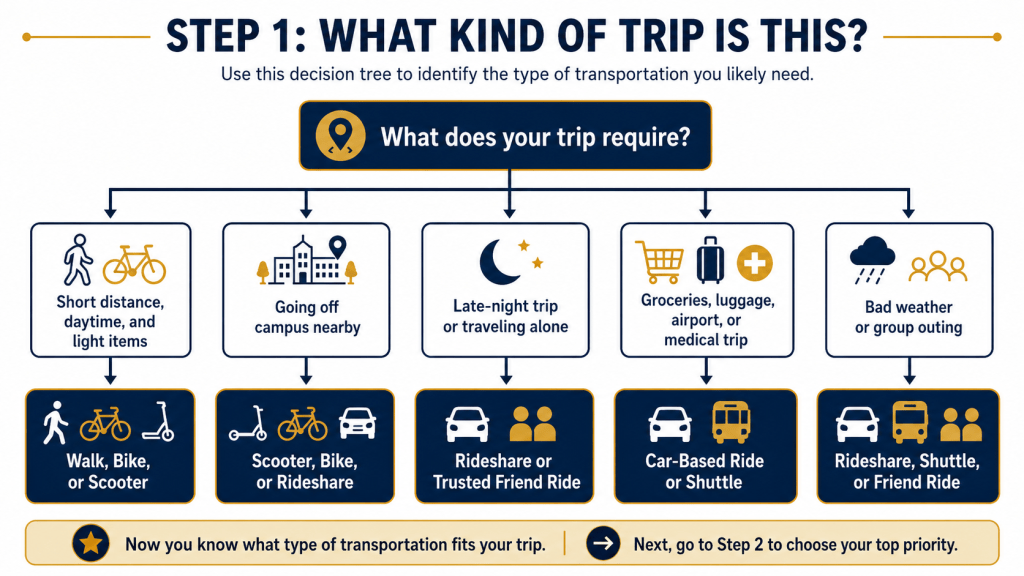
- Step 1: Choose the trip type that matches your situation
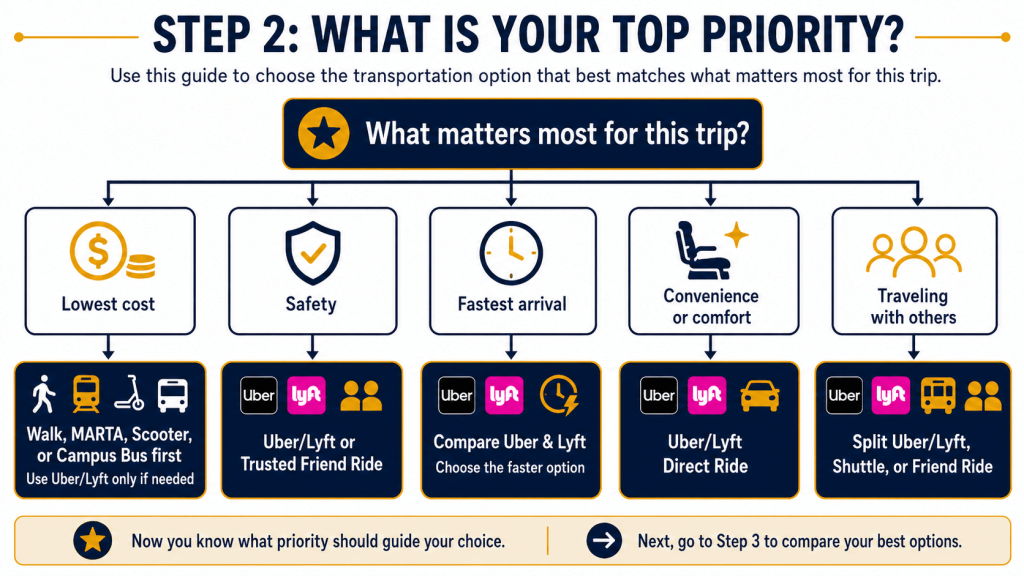
- Step 2: Set your top priority before comparing options
- Step 3: Use the trip table to find your best starting option
- Step 4: Check free or lower-cost options before booking a ride
- Step 5: Compare Uber, Lyft, and other paid options
- Step 6: Avoid expensive travel times when your trip is flexible
- Step 7: Select a safe pickup and drop-off location
- Step 8: Verify the driver and vehicle before getting in
- Step 9: Share your trip and monitor the route
- Step 10: Plan your return trip before leaving campus
Step 1: Choose the trip type that matches your situation
Step 2: Set your top priority before comparing options
Step 3: Use the trip table to find your best starting option

Step 4: Check free or lower-cost options before booking a ride
Before booking an Uber or Lyft, check whether there is a free or lower-cost option that can get you where you need to go. Rideshare apps are convenient, but the cost can add up quickly, especially for students who use them often.
Start by checking campus transportation options, MARTA, grocery shuttles, airport shuttles, scooters, or rides from trusted friends. Some trips may not require a paid rideshare at all. For example, if you are going somewhere close to campus during the day, a shuttle, scooter, or MARTA route may be enough. If you are going grocery shopping, see whether there is a shuttle or whether you can go with friends and split transportation costs.
This step is especially useful when your trip is flexible. If you do not need to leave immediately, taking a slightly slower but cheaper option may be worth it. However, do not choose the cheapest option if it makes the trip unsafe, too complicated, or unreliable.
For On Campus Transportation Guide Visit: https://gthow.com/2025/10/14/how-to-navigate-georgia-techs-transportation-system/
For Campus Scooter Guide Visit: https://gthow.com/2025/03/06/the-smart-commuters-guide-navigating-georgia-tech-with-scooters/
For Marta Guide Visit: https://gthow.com/2025/10/14/how-to-take-the-marta-train-system/
Step 5: Compare Uber, Lyft, and other paid options
If a paid ride is the best option, do not book the first ride you see right away. Open more than one app, such as Uber and Lyft, and compare the prices, wait times, pickup locations, and estimated arrival times.
Prices can be different across apps, even for the same trip. One app may be cheaper, while the other may have a shorter wait time. Also pay attention to the type of ride you are selecting. A standard ride, shared ride, comfort ride, or larger vehicle may have different prices and different pickup expectations.
Before confirming the ride, double-check the destination address. This is especially important in Atlanta because some locations have similar names or multiple entrances. Make sure the app is sending you to the correct place before you pay.
There are also student deals that you can look into to save some money.
| Uber | Lyft | Marta |
| https://www.uber.com/us/en/uber-one/student/ | https://www.studentbeans.com/student-discount/us/lyft | https://www.pts.gatech.edu/commute/commute-options/public-transit/ |
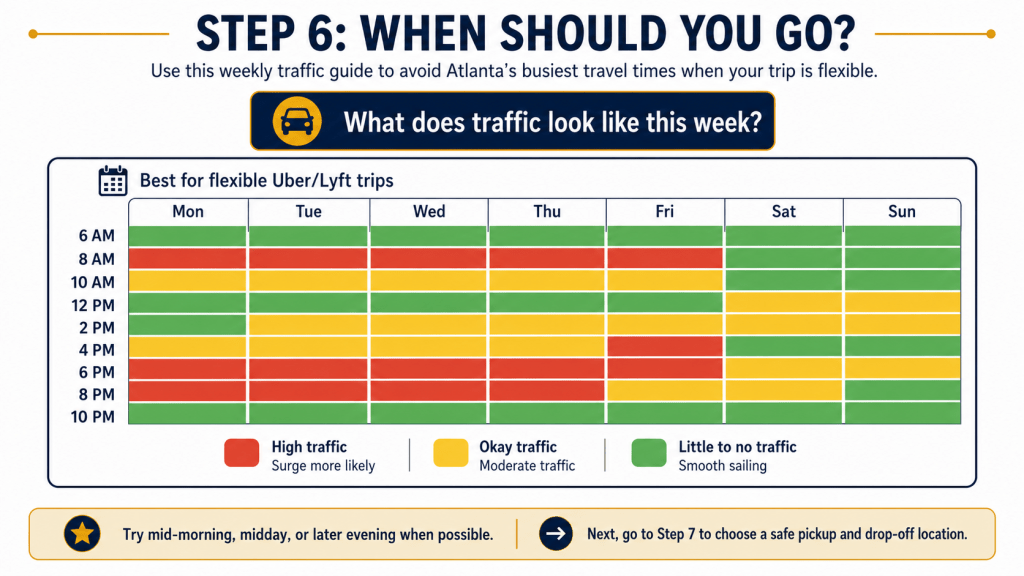
Step 6: Avoid expensive travel times when your trip is flexible
Rideshare prices can increase during busy travel times. This often happens during rush hour, bad weather, major events, weekend nights, airport traffic, or late at night. If your trip is flexible, try checking the price at different times before booking.
For example, if you are going grocery shopping, you may save money by going earlier in the day instead of during evening traffic. If you are going to the airport, leaving with extra time can help you avoid last-minute expensive rides. If you are leaving a concert, game, or crowded event, walking a short distance to a safer pickup area or waiting a little longer may lower the price.
The goal is not always to avoid rideshare, but to avoid paying more than necessary. Planning ahead gives you more control over cost and timing.
Step 7: Select a safe pickup and drop-off location
Before requesting a ride, choose a pickup and drop-off location that feels safe and easy to identify. A good location should be well-lit, public, and easy for the driver to reach. Avoid dark side streets, empty parking lots, confusing intersections, or places where a car cannot safely stop.
If you are near campus, you can also check the community crime map before choosing where to wait or where to be dropped off:
https://www.communitycrimemap.com/?address=Georgia%20Institute%20of%20Technology%20North%20Ave%20NW%20Atlanta,%20GA%2030332
Use the map to be more aware of your surroundings, especially if you are traveling at night or going somewhere unfamiliar. This does not mean every area is unsafe, but it can help you make a smarter choice. If one pickup spot looks isolated or uncomfortable, choose a nearby building entrance, main road, or busier area instead.
Step 8: Verify the driver and vehicle before getting in
When your ride arrives, do not get into the car immediately. First, check that the vehicle matches the information shown in the app. Look at the license plate, car make and model, driver name, and driver photo.
A helpful safety habit is to ask the driver, “Who are you here to pick up?” instead of saying your name first. The correct driver should already have your name in the app. If the driver, vehicle, or license plate does not match, do not get in the car.
If something feels wrong, step away from the vehicle and cancel the ride if needed. You can request another ride or move to a safer location. It is always better to wait longer than to get into the wrong car.

Step 9: Share your trip and monitor the route
After you get into the ride, share your trip with someone you trust. Most rideshare apps have a feature that lets you send your live route and estimated arrival time to a friend, roommate, or family member.
During the ride, keep your phone available and monitor the route. You do not need to stare at the map the entire time, but you should pay attention if the route changes unexpectedly or if the driver goes in a direction that does not make sense. Sometimes route changes happen because of traffic, but it is okay to ask the driver about it.
If you ever feel unsafe, use the safety tools in the app, contact someone you trust, or ask to be dropped off in a public, well-lit location. Trust your instincts if something feels wrong.
Step 10: Plan your return trip before leaving campus
Before you leave campus, think about how you will get back. This is especially important if you are going somewhere late at night, visiting a new area, going far from campus, or relying on transportation that may stop running later.
Check whether MARTA, campus transportation, shuttles, or rideshare options will still be available when you plan to return. Also think about whether prices might be higher later, especially after events or during weekend nights. If you are going with friends, decide ahead of time whether you will return together or separately.
Planning your return trip helps you avoid being stuck somewhere without a safe or affordable way back. Even a simple plan, such as checking the last train time or saving enough money for a rideshare, can make the trip much less stressful.


Leave a Reply