

By: Fareed Abdul-Latif & Brian Yang
Introduction
This guide targets incoming first-year and transfer students, helping them to learn the dining options on campus and in Tech Square. Students who lack reliable access to a kitchen, or who don’t have the time or desire to cook, will eventually look for other places to eat. However, with so many choices, new students can easily feel overwhelmed. We plan to consolidate all the dining options into one article (outside of just the usual dining halls), with the description, location, and hours of each spot; which options fit different dietary needs; and explain how Dining Dollars, Grubhub, and budgeting work. After reading the guide, students should be able to grasp what Georgia Tech has to offer food-wise and make the best selections from the many options available to them.

Step 1: Explore Campus and Tech Square
Your first few days on campus (if time permits) should be spent partly by visiting the student center and Tech Square. Not only will this allow you to get your bearings around campus before classes begin but it will also allow you to start identifying the location of viable food spots on campus. Key areas to check out include the student center (which is where most of the popular/most easily accessible options are located), CULC (for quick snacks), and of course the main Tech Square along with its connecting streets (which have “out the way” restaurants you could visit). There are also food trucks located around campus that reside around Tech Green, Ferst Drive, and the alleyway by Tech Tower, offering additional options and flexibility based on your schedule. See which locations pique your interest and take note (either mental or physical) while exploring.
Step 2: Gather Key Information
The next key step is to perform a little bit of research. For each location identified from the previous step, take some time to note down the locations, hours, prices, and options offered by each spot in addition to their relative level of busyness, which will be essential information to use when creating your ideal “food rotation.” Note that it may take a couple visits before you are able to make this assessment.
Step 3: Match Options to Dietary Restrictions
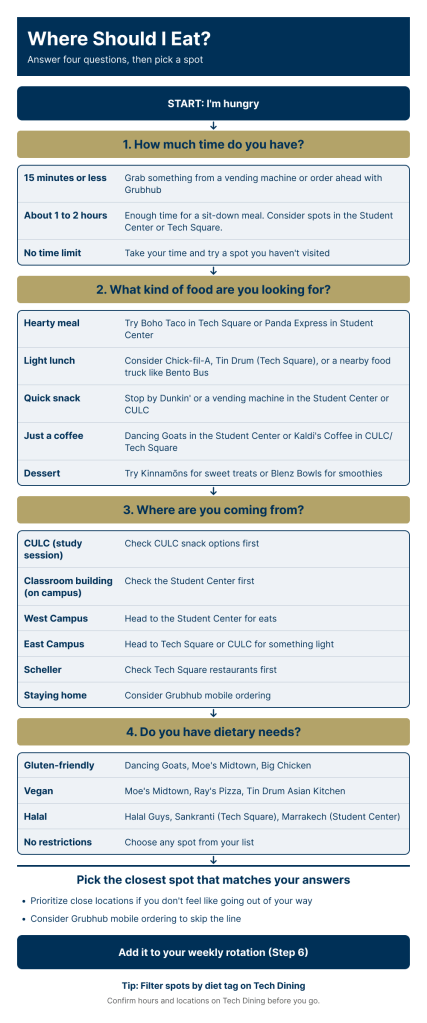
After gathering this information, the next step is to begin filtering out options based on your dietary restrictions. Many eating locations accommodate for those allergic to gluten like Big Chicken and Dancing Goats. For those looking for vegan options, viable options include Moe’s Midtown at Georgia Tech, Ray’s Pizza, and Tin Drum Asian Kitchen on Tech Square. Likewise for halal options, consider visiting Halal Guys or Sankranti while at Tech Square or Marrakech while at the student center.
Searching for Food Accommodations
One easy way to identify which eating locations accommodate specific dietary restrictions is to visit Tech Dining and perform a search filtered on a selected tag (e.g., Gluten-friendly, Kosher, Halal, Vegan). Use this to further narrow down your list of options before moving onto the next considerations.
Step 4: Understand Dining Dollars
For those who have the applicable meal plans, your eating plans should factor in dining dollars. As described on Tech Dining (Georgia Tech’s page for all things meal plan related), Dining Dollars are sales tax exempt funds that can be used at all Tech Dining locations. Although these funds are primarily intended to be used within the three on-campus dining halls (North Avenue, West Village, and Brittain), it is important to note that there are other locations on campus that accept dining dollars. For example, Chick-fil-A, Panda Express, and Dunkin’ are such restaurants on-campus that accept dining dollars as payment.
Further Details on Dining Dollars
Dining Dollars are included in some meal plans and may also be purchased in increments of $50, $200, $400, and $600. If you do deposit $400 or $600 in Dining Dollars, you will receive an additional 10% bonus Dining Dollars. Furthermore, Dining Dollars roll over from summer semester to fall and from fall semester to spring; however, unused Dining Dollars at the end of the academic year (spring semester) will be forfeit. If these funds are available, they can be a smart way to add flexibility to your eating routines without straying away from a preexisting meal plan.
Step 5: Order Ahead with Grubhub
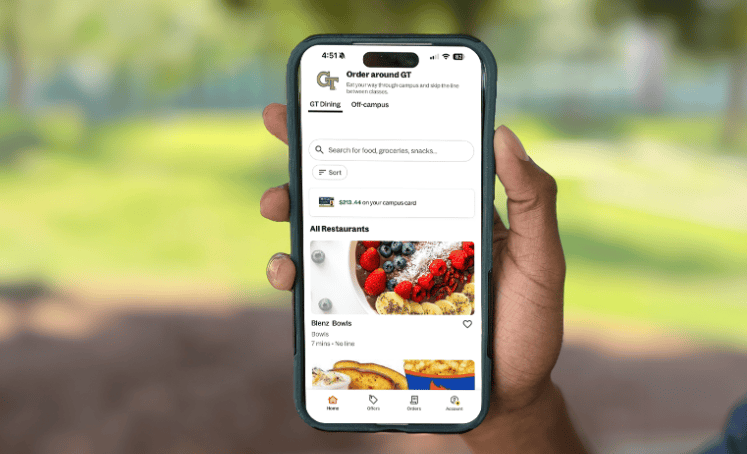
Grubhub, the mobile food ordering and delivery app, has partnered with Georgia Tech to offer pre-order pickup from dining locations on campus, with the notable exception of Chick-fil-A. By syncing a Grubhub account with Georgia Tech, students can use BuzzCard funds, Dining Dollars, or other payment methods. Grubhub is especially useful when you are nearby but short on time, letting you order ahead and skip the crowd so your food is ready the moment you walk in.
Step 6: Strategize to Avoid Menu Fatigue
As the semester ramps up, students may find themselves rotating through the same one or two meals all week. Although routine can greatly simplify decision-making, a lack of variety can quickly lead to palate fatigue, nutritional deficiencies, and overall burnout. To avoid this, we recommend that students compile a list of go-to dining options tailored to different everyday situations.
For example, if you need dinner after your late afternoon class in Scheller College of Business, having a preselected list of spots that offer quick, balanced meals saves you from defaulting to routine or whatever is closest. This approach can be applied across your entire schedule, introducing options that may have inadvertently been ignored.
Step 7: Build a Budget
College is often the first time students manage their finances without anyone looking over their shoulder. While that freedom is exciting, eating out often is an expensive endeavor incoming students are likely not aware of yet. Although grocery shopping and cooking at home fall outside the scope of this guide, building a realistic dining budget remains essential.
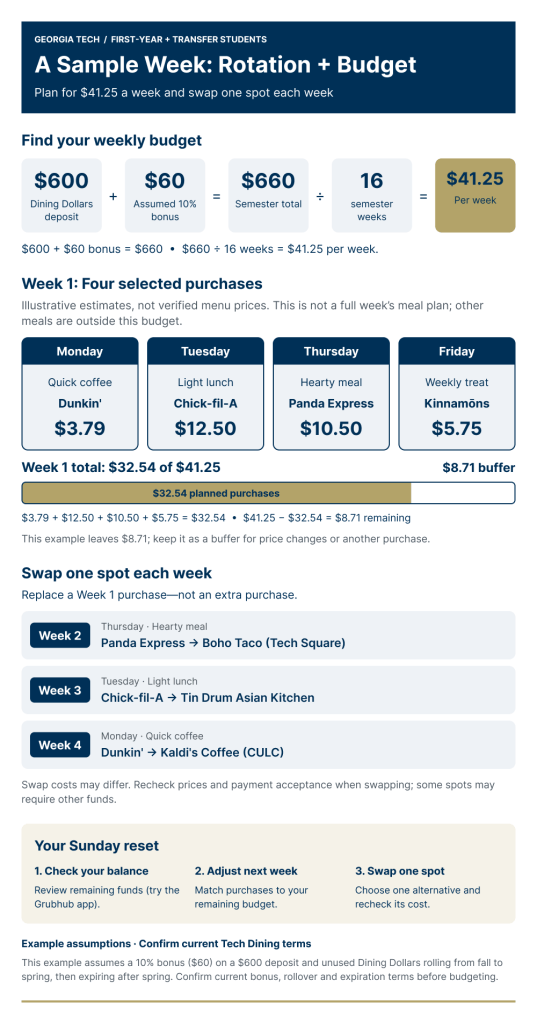
A budget should include how much you’re willing and/or able to spend on eating out every week or month. If you are relying on Dining Dollars for meals this can be easily done by dividing the amount you have by the number of weeks in a semester. For example, $400 and earn the 10% bonus, your $440 stretches to about $29 per week. To make things easy for yourself, track your balance in the Grubhub app every Sunday so you can adjust before the money runs out.
Conclusion:
You now have a plan for eating well at Georgia Tech: explore, filter by diet, use your funds, order ahead, rotate, and budget. Start small. This week, for example, visit one new spot and add it to your rotation. Each new place makes the next decision easier.


Leave a Reply