
By Sebastian Morgenstern and Aidan Nguyen
Introduction
Every first-year and transfer Computer Science (CS) student at Georgia Tech must complete a junior design requirement in order to graduate. This requirement is intended to give students experience beyond the classroom while helping them build technical communication, teamwork, and problem-solving skills relevant to research, industry, and entrepreneurship. Because the choice of junior design path can shape future internship, research, and academic opportunities, many students find it difficult to decide which option is best for them.
Georgia Tech offers four main junior design options: a capstone project-based course, a Vertically Integrated Project (VIP), an institutional research option, and a startup-focused entrepreneurial option through CREATE-X. Each path differs in workload, structure, resume value, leadership opportunities, and overall experience.
This guide is designed to help first-year and transfer students make an informed decision by breaking down the pros, cons, tradeoffs, and expectations of each option. In addition to explaining the four major paths, it also helps students navigate the sub-options within them, such as choosing a specific VIP team or capstone project. The guide also outlines how to apply for and register for each option, helping students new to Georgia Tech understand the process from start to finish. Use the steps below and the information throughout the guide to narrow your choices and decide which path fits you best.
Table of Contents
Steps
- Determine your requirements: this guide is aimed towards students with no applicable credits to their junior design requirement. If you have credits that may transfer, discuss with your advisor to see what still needs to be fulfilled. See the Degreeworks section below
- Find your passion: the best junior design option is the one that you are most interested in. Look through the information below and browse through project and research options to see if anything piques your interest.
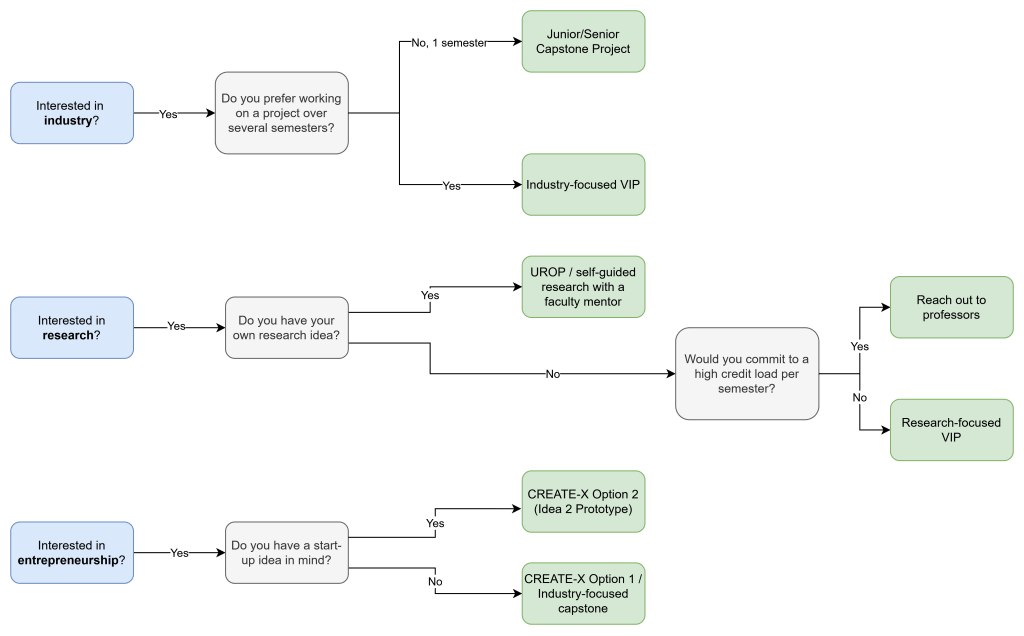
- Consider your career: are you interested in going into research or industry? Are you thinking about making your own start-up? Is there an industry that you want to learn more about but are not sure how? Consider these questions to weigh the benefits of each option.
- Think about time: each option has a different amount of work distributed across a differing number of semesters. Sometimes, the time commitment is not as straightforward as the number of credit hours a class is. Make sure to consider the workload, time commitment, and time to graduate when making a decision.
- Discover social and leadership opportunities: each option exposes you to different team and leadership dynamics. Do you only want to work on a team in a class setting? Would you prefer working under professors and graduate students in a formal research setting, or work in a club-like team environment? Are you interested in leadership opportunities in the future? These are all things to consider when deciding whether a team is right for you.
- Brainstorm, reach out and apply (as necessary): many options require a prerequisite idea, connection, or accepted application before registration. Make sure to reach out to professors and apply to programs by the deadline (if necessary); if you can’t get into the research lab or VIP that you wanted, now is the time to consider your other options. Some junior design options (like the CREATE-X Option 2) require a prerequisite start-up idea, so start thinking about that now.
- Register for classes: registration is different for each option, but you’ll need to register for the relevant classes in order to get institute credit for your junior design work. Once you’ve settled on what you want to do and have been accepted into the program (if necessary), you’ll register for classes in OSCAR, the Georgia Tech registration site, like most of your other classes.
- Occasionally, permits are necessary to register, but you’ll typically get an email with more information on how to register for classes if there is a more complex process. Make sure to reach out to your advisor with any questions, and make sure you’re registered before the Phase II deadline, or you won’t be able to get credit for that semester!
Understanding the Junior Design Options
At Georgia Tech, junior design is a sequence of courses and/or project work that all CS majors must take to graduate. There are 4 junior design options, and each option differs by field, workload, experience type, social setting, and more. Choosing the right option for you can be a daunting task, but don’t worry, this is why we made this guide!
To get started, here is a brief description of each option:
- Vertically Integrated Project (VIP): VIPs group undergraduate and graduate students together on a project designed to research or build projects. There are many diverse VIPs, each with different amounts of research, competition, and industry focus.
- Junior/Senior Capstone Project: Capstone project groups work on projects to build a minimum viable product (MVP) based on a set of company or institute requirements. There are various projects to choose from, but project options are typically industry or entrepreneurship focused.
- Institutional Research: Institutional Research is a great way to get credit for doing research you may already want to do. Any undergraduate research for credit counts towards fulfilling this requirement.
- CREATE-X Option 1: Also known as CS 4883-X, in this CREATE-X junior design option you work in groups to brainstorm and create a startup while learning the entrepreneurial lifecycle. No initial idea is required.
- CREATE-X Option 2: This CREATE-X option involves Idea 2 Prototype (I2P), where you take your own startup idea and get credit for building out a prototype and progressing the startup.
Here we already begin to see some patterns and differences. If you are already planning to do undergraduate research, or are very interested in it and want to avoid taking more classes to fulfill your junior design requirement, doing the Institutional Research option might be an obvious choice. If you’re more interested in learning about entrepreneurship and making your own startup, the CREATE-X options may be best for you. The Capstone Projects lean towards a more guided, industry-focused project approach, which can teach valuable skills in industry, while VIPs offer many team choices that blend research and industry focus.
Semester Overview and Workload
Each junior design option requires different courses to be taken in different sequences. As a quick overview of the courses required and their respective institute-recommended workloads, see the table below. Notice that beyond the project and technical coursework requirements, each option has at least one technical-communications-focused class (e.g. LMC 3403).
| Semester 1 | Semester 2 | Semester 3 | Minimum Total Hours | |
| VIP | VIP Semester 1 (1 hour) | VIP Semester 2 (2 hours) | VIP Semester 3 (2 hours) + LMC 3403 (3 hours) | 8 |
| Capstone Project | CX 3803 (3 hours) + CS 3803 (3 hours) | 6 | ||
| Institutional Research | Undergraduate Research CS 2699/4699/4980 (3 hours) | Undergraduate Research CS 4980 (3 hours) + LMC 4701 (1 hour) | Undergraduate Research CS 4980 (3 hours) + LMC 4702 (1 hour) | 11 |
| CREATE-X Option 1 | CS 4883-X (3 hours) | LMC 3403 (3 hours) | 6 | |
| CREATE-X Option 2 | CS 2701 or CREATE-X I2P (3 hours) | I2P CS 2699/4699 (3 hours) | LMC 3403 (3 hours) | 9 |
*Note that although one option may require less total credit hours than another, many factors play into the workload and time-commitment for each option. A further explanation of the course requirements for each class can found in the Steps For Junior Design Capstone Options article.
Vertically Integrated Projects (VIPs)
Choosing a VIP
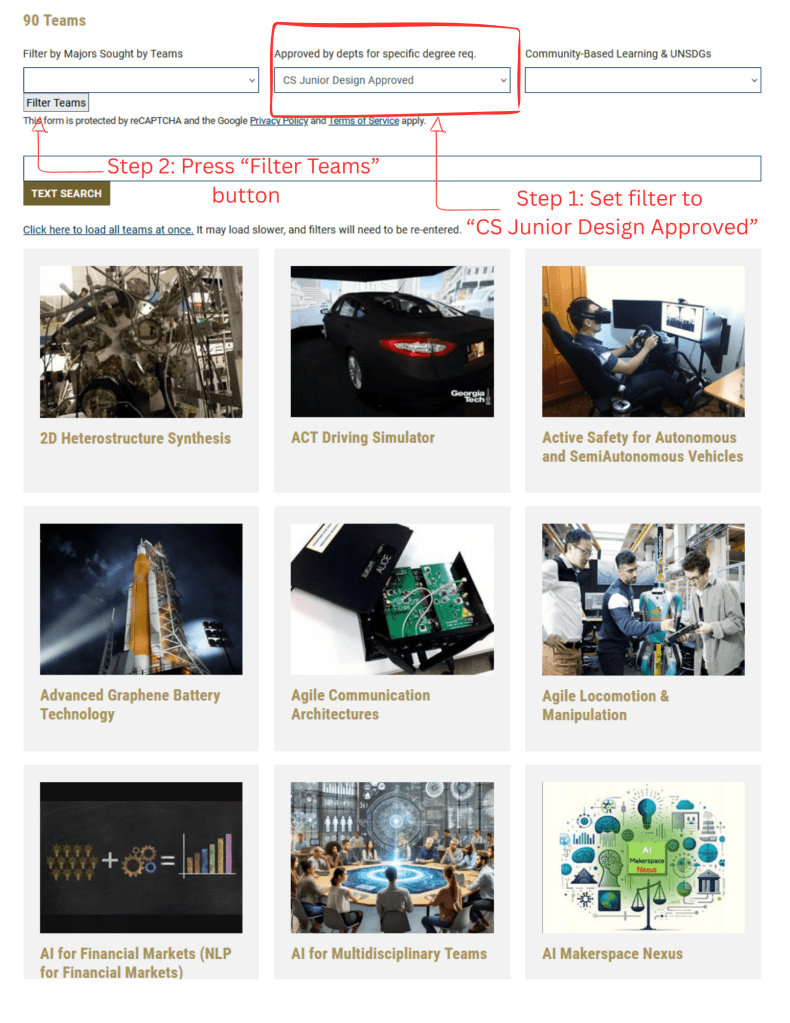
At the time of writing, the VIP website lists more than 100 teams spanning areas such as robotics, sustainability, machine learning, autonomous systems, and computing for social good. Because VIP is designed to be both multidisciplinary and long-term, your experience will depend heavily on the specific team you join. When choosing a VIP, it is important not to pick based on the title alone. Instead, consider the following factors:
- Project Mission: Read the team description and ask yourself whether the project’s overall goal is something you genuinely care about. Since CS students using VIP to fulfill the junior design requirement must remain on the same team for at least three semesters, it is important to choose a project that will hold your interest over time.
- Type of work: VIPs differ significantly in type of work, from heavily research-focused teams to mainly industry-focused ones. Many offer a great intersection, which many students value due to the diverse and interesting experience. Research-focused teams are mainly geared toward publication, but frequently involve building and design through iteration. Industry-focused or interest group teams are typically focused on building something, but are frequently involved in simultaneous research. Look into the type of work for each option to see if it aligns with your career goals.
- Team culture: Even teams with similar technical goals can feel very different in practice. Some provide structured mentorship and clear guidance, while others expect students to be more independent and self-directed. Think about the type of environment in which you do your best work.
- Leadership potential: One of VIP’s greatest strengths is the opportunity for long-term growth. Returning students can often take on roles such as subsystem lead, onboarding mentor, or operations lead. If you want a junior design option that allows you to stay involved beyond the requirement and gradually grow into leadership, VIP is one of the strongest choices.
A practical way to narrow your choices is to make a short list of three to five teams and compare them on interest level, expected workload, desired skills, and team structure. If one project clearly excites you more than the others, that is usually a strong sign. Try to talk to other students, too! Usually at least someone knows somebody that is in a specific VIP who can give you inside knowledge and potentially a tour into what it’s like working on the team.
Application and Registration
For CS students using VIP to fulfill the junior design requirement, the standard path consists of three semesters on the same VIP team, for a total of at least five VIP credit hours, plus LMC 3403. The typical sequence is 1 credit hour in the first semester, followed by 2 credit hours in each of the next two semesters. LMC 3403 is often taken during the final VIP semester or afterward, and many students defer it until their graduation semester. VIP 2 and VIP 3 courses must be taken at the 3000/4000 level.
Before registering for a VIP, students must first apply through the VIP website. The application website also provides more detailed information about the process and expected workload. Our main advice is to take the application seriously: tailor your resume, relevant experiences, and statement of interest to the specific team you are applying for. While some VIPs may be less selective, others can be more competitive, so it is always worth putting forward your strongest application.
Sebastian’s EcoCAR Testimonial

“Choosing to join EcoCAR was one of the most influential decisions of my college experience. I joined in Spring 2024 after browsing the VIP website and thinking it would be cool to work on cars. Now, it’s Spring 2026, 3 semesters after I had completed my VIP requirement, and I’m still working on the team! I started off doing basic work on the autonomous driving subteam, where I learned so much about the automotive industry and autonomous driving stacks. Over the semesters, I took on more and more responsibility, became an undergraduate lead for the subteam, and continued to work, test, and travel with the team to competition events. Along the way, I’ve made good friends that make my time at the shop so fun and enjoyable.
One thing that I didn’t realize about VIPs was the amount of social interaction; at the end of the day, it’s a team, and we have had a lot of formal and informal team-building events that make it feel like more than just an engineering team. I used to dread traveling for events, but now it’s one of the things that I will miss most because I was able to see all of the cool testing facilities and explore new places with the team. Eating team dinners after a challenging day of engineering teamwork will never not be fun. I’ve also learned so much from the other members of the team; working on such an interdisciplinary project exposed me to knowledge and concepts that I didn’t know existed. Everyone is extremely smart and willing to share knowledge, and now it’s been fulfilling to give back by teaching the new members of the subteam.
Overall, I would highly recommend doing a VIP because of the fulfilling interdisciplinary engineering challenges that you’ll be able to solve while working with people that are not only your teammates, but your friends. You’ll have access to resources, tools, and knowledge bases that are not only fun to work on, but also critical for learning the skills to make yourself marketable in industry. My involvement with EcoCAR has given me the experience to land several automotive internships and even non-automotive jobs because of the stories and experiences I’m able to tell. Some weeks feel challenging and frustrating, but I’ve never regretted my decision to stay on the team. Every VIP team is different, but I believe you can’t go wrong by finding an interesting VIP and staying committed: you’ll make amazing friends, learn valuable skills, and see cool stuff that nobody else can.”
– Sebastian Morgenstern
Junior and Senior Capstone Project
If you are someone who is attracted to ideating and developing a project through its full lifecycle, you may be interested in the course option for junior design. Over the course of a semester, you and 4 other students will analyze a problem for a customer, then manage various parts of a solution, including UI, project design, demonstrations, and more. To decide if the course option would be right for you, keep the following in mind:
- Course load: All students starting the project course after Summer 2025 must complete it over one semester in a 6 credit hour timeblock (CX 3803 + CS 3803). Consider if completing your junior design requirement in one semester with heavy involvement would be preferable to spreading it out over several semesters.
- Project ownership: In this course, you will have significant ownership over the direction of the project, and thus a greater sense of long-term ownership. If you prefer working on smaller, pre-established projects, consider if another junior design option is better for you.
Note: The above relates to the Summer 2025 and after version of the project course option. If you already have credit for CS 3311/LMC3432, refer to the “Project Class: Classic” section of the Junior Design Steps document.
Students will typically be assigned a capstone team, which they will work with to build a project from the ground up. Project teams focus on industry or entrepreneurial projects that help students learn engineering communication, teamwork, and organization. More information on the projects offered is available on the Georgia Tech Student Experience website.
CREATE-X: Entrepreneurship as a Class and Project
Are you someone who is excited by the idea of being an entrepreneur? If so, the CREATE-X program offers two paths for you to learn about invention, business models, prototyping, and other processes to aid you in developing your own business ideas. For junior design, entrepreneurial options could be best for students who want to combine technical work with customer discovery, idea validation, and business thinking.
Option 1: Interdisciplinary Project Class
This option is best for students who are interested in pursuing entrepreneurship but do not already have a startup idea they are committed to pursuing. In this option, students work in teams to identify real problems, explore whether those problems matter to users, validate whether a market need exists, and then build an MVP. This option is also great if you want to practice researching, managing, and working on a project that involves different majors and industries.
Option 2: Start-up Lab and Idea 2 Prototype (I2P)
This option is for students who already have a startup direction they want to pursue more seriously. In the CREATE-X ecosystem, Idea to Prototype and startup-oriented capstone paths are meant to help students move from concept toward real validation and a functioning prototype. In this option, interdisciplinary teams work on their startup product idea, explore market demand and value proposition, and receive mentorship and support; top teams may even feed directly into Startup Launch.
How to choose an option:
Think about the following when you are considering the CREATE-X option for your junior design:
- Option 2 involves roughly 6 hours of effort outside of class to interview people and explore real-life business models.
- Option 2 of the CREATE-X path (Start-up Lab and I2P) requires that you have an idea going into the program. If you have no startup ideas but are interested in making a startup, Option 1 (Project Class) might be a better fit since brainstorming is incorporated into the timeline of the course.
- Both options take 1-2 semesters and 6-9 credit hours to complete. If you prefer a lower course load over multiple semesters rather than a heavy commitment for 1-2, consider the VIP option.
Undergraduate Research
The research option is a great choice for anyone wanting to get into grad school or anyone wanting to contribute to publishable research.
There are two research for credit options:
- Joining a professor’s established lab
- Working on an individual project under faculty supervision
Regardless of the option you choose, you’ll typically need to have researched under a professor for at least one semester before they will be your faculty advisor. The section below discusses how to find research labs and professors that may serve as your faculty advisor.
Professor outreach
For many students, the hardest part of the research option is not the work itself but finding a faculty mentor. That process can feel intimidating, especially if you have never done academic outreach before.
- The first step is to find a few labs or research projects that you’re interested in. One good way to find professors is to scroll through the College of Computing faculty website, where you can then click on professors, which takes you to their personal page, which typically lists the research they are involved in.
- Reach out to professors who do research that you are interested in. If you’re currently taking a class taught by a professor that you’re interested in working with, go to office hours to talk more! If you know someone already working with the professor, ask for an introduction or talk more with them to get more information.
- If you can’t find any connection to a professor, try cold emailing all of the labs that you’re interested in. Some faculty are busy and may not respond, but hopefully you’ll get at least one response. Cold emails sent should be friendly, show specific interest, and give a brief history of relevant experience and coursework. An example email might look like:
Dear Professor [Name],
My name is [Your Name], and I am a CS student at Georgia Tech interested in undergraduate research in [area]. I came across your lab’s work on [specific topic], and I found it especially interesting because [1 sentence of genuine connection]. I have taken [relevant classes] and have experience with [relevant skill/project]. I was wondering whether you are currently accepting undergraduate researchers for credit.
Thank you for your time.
Sincerely,
[Your Name]
Conclusion
Extra Resource 1: Degreeworks
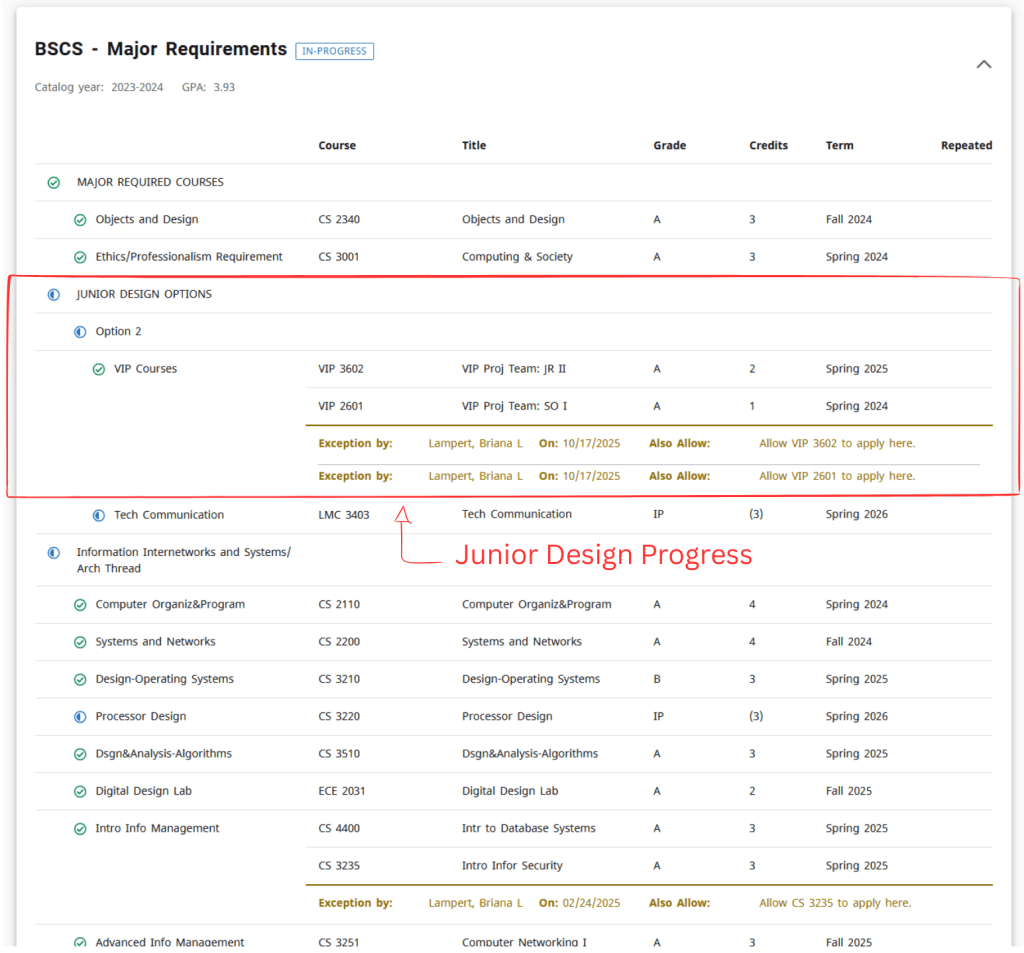
DegreeWorks is a thorough and comprehensive overview of the classes that you’ve taken and what classes you need to graduate.
Though not guaranteed to be entirely accurate, it’s a great resource to reference when planning out your semesters at Tech.
Use DegreeWorks early rather than late. Before registering for any junior design path, confirm what requirements you still need and whether any transfer credit or unusual circumstances affect your plan.
Junior design interacts with communication requirements, so it is important to verify that the associated LMC and communication components will be satisfied.
Extra Resource 2: Advising
When it comes to anything related to registration or meeting graduation requirements, your advisor is one of the best resources that goes frequently underutilized. This is especially true for junior design because details can change.
The College of Computing website notes that junior design information is updated and that the most up-to-date information for specific items can be found in student alerts and by checking with an advisor.
- The site also has instructions on how to find your advisor along with further junior design information.
- A short advising appointment can save you from taking the wrong communication course, assuming an old capstone structure still applies, or misunderstanding how research credit counts, all of which could accidentally delay graduation by a semester.


Leave a Reply