

A practical guide for Georgia Tech students to use AI tools responsibly while improving learning, productivity, and academic integrity.
By Christopher Castaneda, Amanuel Ayalew, Pranav Aluru
Introduction
Many students at Georgia Tech are already familiar with AI tools such as ChatGPT, but are only able to utilize its basic chat functionality and are unsure of how to utilize this technology to assist learning in a meaningful way. As this technology continues to be more integrated into schoolwork, students may find themselves becoming too reliant on quick answers rather than learning for the long term. This is a relevant topic for students at Georgia Tech, as many are feeling a great deal of pressure to perform well while also juggling a heavy workload, making this a very relevant topic for students to learn about, as it is becoming increasingly important for students to utilize this technology in an effective yet ethical manner. This procedural guide will provide Georgia Tech students with practical, step by step strategies for using AI tools beyond basic chat prompts in ways that support deeper learning, maintain academic integrity, and improve overall academic efficiency. In addition, the guide will introduce students to different ways AI can be incorporated into the learning process without replacing critical thinking. For example, the guide will demonstrate how AI can be used to generate study plans, explain difficult concepts, check understanding, and help students organize information from lectures and assignments. It will also give tips on how to verify the AI-generated answers and when it is best to use the old-fashioned way of learning. By clearly presenting these concepts in an easy-to-understand manner, the guide will help students decide when to use AI as a learning tool in their studies.

Table of Contents
- Easy Seven Step Plan
- Step 1: AI Decision Making
- Step 2: Prompt Building
- Step 3: Example Usage
- Step 4: Fact Checking
- Step 5: AI for Deepening Understanding
- Step 6: AI for Organization
- Step 7: Balancing AI and Critical Thinking
- Case Study
Steps
This is a step-by-step guide for how to best use AI to effectively preserve course learning outcomes while still using AI to accelerate your learning experience without sacrificing grades.
Step 1: Decide When to Use AI for Learning
To use an AI tool, you need to decide whether you need the help of the tool or if you can work it out on your own. It is best when you know the subject but need help organizing ideas, concepts, or information. For instance, an AI tool can help summarize notes or explain difficult concepts. Using an AI tool is not necessary when you need to use original thinking, such as when writing essays or completing homework problems that need to be graded.
Step 2: Start with Clear, Learning-Focused Prompts
To use an AI tool, it is essential to ensure that you are not using it to get answers but rather to get help in understanding the subject matter. When using an AI tool, it is essential to ensure that your prompt is clear, focused, and learning-oriented. Avoid using negative qualifiers (“not”, “no less”, “don’t”, “never”, etc.) in prompts as LLMs have a difficult time understanding them. In addition, it’s often helpful to have an AI adopt a persona relevant to the task, like a TA or a famous author. Understanding that LLMs which form the basis of AI agents/tools are statistical approximation machines, not analytical machines, can take your prompting a long way.
Step 3: Use AI to Break Down Tough Concepts
Once you identify a suitable scenario and have considered how to efficiently prompt, you can proceed to as AI tools to break down confusing or difficult concepts and act as an additional resource alongside textbooks and the broader internet. Often times, textbooks teach in an abstract manner and reference material from hundreds of pages prior, and AI is the perfect remedy to this problem. It can, for example,
- Break down esoteric concepts into multiple steps with explanations and relevant prior material for each.
- Provide concrete examples or use cases that help you connect the concept with it’s purpose and useful properties
- Pull together multiple explanations/viewpoints on the topic via web search capabilities or recall hundreds of pages of context.
- Customize responses exactly to your needs rather than optimizing for an entire population of students.
Step 4: Check AI Information
The information provided by AI sometimes proves to be incorrect or outdated. Therefore, it is always best to verify the information provided through textbooks, lecture notes, and other reliable sources. There are a few practical ways to do this, even if you lack the time to verify every single outputted word. For one, always ask the AI to provide references for any facts or information it uses. This simultaneously reduces hallucination and allows you to view the original sources of information the AI finds to answer your query through web search. You may also question the AI on any specific results you plan on using, forcing it to defend or re-examine how it came to that conclusion to a satisfactory level.
Step 5: Make AI Your Study Partner
One of the most underutilized aspect of AI is its ability to guide your reasoning. Consider how you might collaborate with a study partner, reviewing notes. There might be a topic that the two of you come across and vaguely remember. You might debate it back and forth for some time then continue with your studying. Now consider with AI as the study partner. The AI, of course, knows what the topic is already, but instead of asking it directly, you can prompt the AI model to “guide further critical thinking”. You can then check an implementation of an idea with AI and ask it to, instead of saying “yes” or “no”, poke holes in your reasoning. For instance, saying “I believe that net force in a free body diagram is equal to gravity when an object at rest because objects that don’t move are stuck on the ground because of gravity”. Instead of correcting you, the AI model will be able to say “Well, if that were the case, what would that imply about Newton’s second law?” Such a method allows you to discover logical contradictions, and for even more powerful guidance, we can consider integration with our next step.
Step 6: Let AI Organize Your Notes and Plans
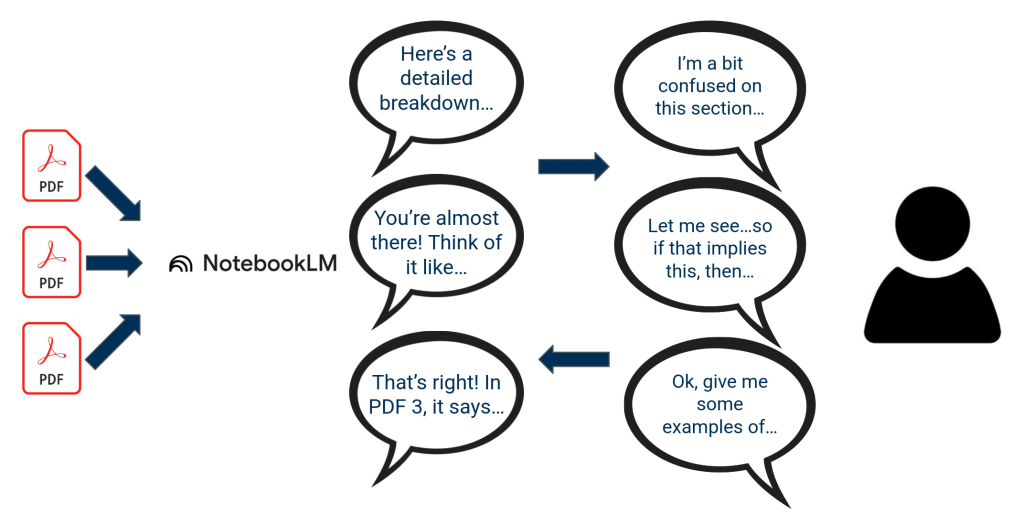
You can also make the best use of AI by asking it to organize your lecture notes, key concepts, and information before the exams. For instance, you can enter a few topics and ask AI to prepare a study plan for the upcoming week. This will definitely help you manage your time effectively during the semester when things get busier. One such tool for this is NotebookLM, an AI assistant that takes known material, such as study guides and papers, and reviews them, generates practice questions, exams, and can even grade responses directly in the service. Below, we provide a visual example of such a workflow. Google provides a useful starter guide for using the tool, and this guide aims to supplement the starter guide by outlining a clear usage pattern conducive to meaningful learning.
Step 7: Balance AI with Your Own Thinking
A central theme with all of the previous steps above has been balance. More specifically, it has been about balancing the tremendous power of AI to solve almost any problem with the goal of actually learning and mastering material. This final point will stress this most of all. As a statistical prediction engine, AI will always give the most likely answer. As time has gone on and AI is trained on more and more material, the AI models have naturally seen more of the work that students have completed, meaning they almost always give correct answers to questions for students across various domains. Too often, grades are the final goal, and AI is one of the most powerful means to that end. However, balancing AI with your own thinking does not have to forego the possibility of earning good grades in a more efficient way. Balancing AI can be best accomplished by challenging responses given by models, asking follow-up questions, and using example statements. For example, if an AI model clarifies a topic, try giving the model itself an example. This sort of thinking pattern is one of the best ways to balance critical thinking with AI usage. Additionally, when asking follow-up questions, provide your intuition. AI can be best used in a balanced way to check reasoning, where when you ask a question, you try guessing the answer and explaining why. Providing your thought process gives the AI model maximum insight into your decision making and, by extension, enables it to help you where it matters most. With the points we have outlined, using AI will be a rewarding experience that helps you prepare for exams, master coursework, and excel in school without sacrificing true learning.
User Study
To see how our process actually works in practice, we conducted a user study on a student volunteer who did not use AI in their day-to-day workflow. This student participated in three separate classes within the computer science major, namely Operating Systems, Design and Analysis of Algorithms, and Information Security. Below, we provide the results of timing his results. The student was told to simply stop once he felt that he understood the material sufficiently, and also complete a practice exam of the material afterwards.
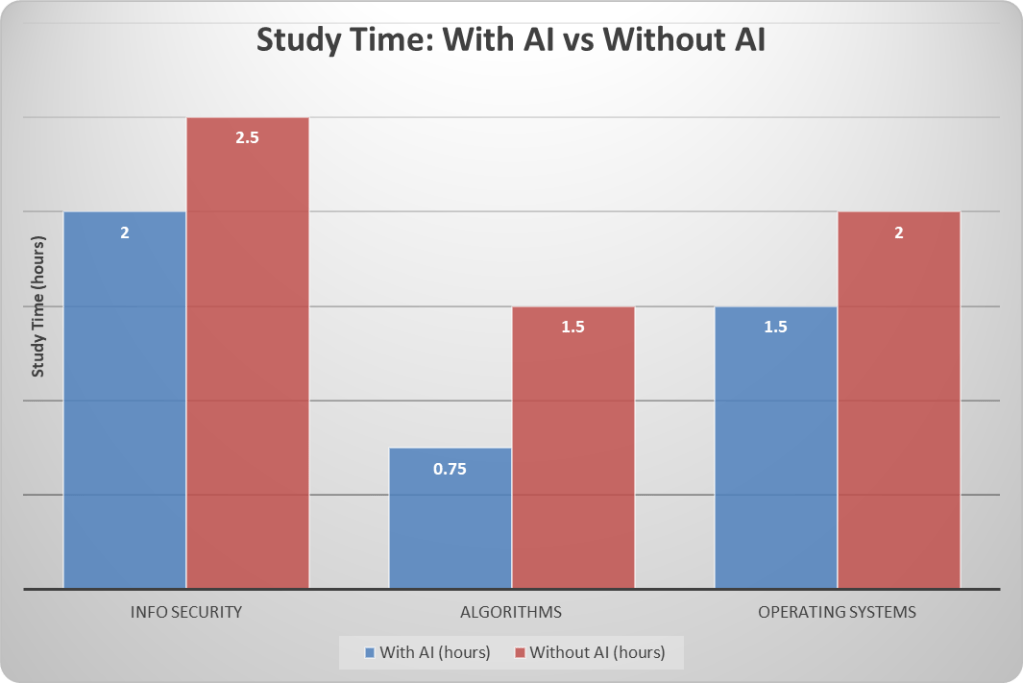
As shown above, the bar chart for the student using AI is significantly improved. Overall, the student achieved similar levels of mastery on the post-studying practice exam after using the outlined study plan. This shows that the approach outlined above is effective in helping students achieve mastery in less time with AI.


Leave a Reply