
An ultimate guide to dominate your peers
By: Adwaith & Esther
Introduction
Imagine a student struggling on a group project. She is unable to coordinate with her teammates, and is thus left to do all the work alone. Communication breaks down and the student gets frustrated at the position she is left in. She turns to the vast and wide internet, where she finds this beautiful article solving her predicament.
Her eyes dart across the screen, and slowly widen. A smug smile forms across her lips as the realization hits her. She now has the power to command her team and never be the one doing all the work alone ever again.
When the professor assigns the next group project, she goes to her team and uses the techniques she learned from the article. Her teammates stumble, unable to create coherent arguments to counter her points. In the end, she becomes the one on top, commanding her “servants”, equally sharing the work and winning every group argument.
Our article isn’t just another How To. It is an ultimate guide that will change your life. When you learn the techniques presented, you too will never have to do a project solo because your teammates did nothing. You will command your team to get the work done smoothly without hiccups.
Table of Contents
Step 1: Gather Concrete Evidence Before Declaring Your Teammates’ Guilty
It is rookie behavior to simply accuse a parasite of doing nothing without providing any evidence. Sit down and open up your laptop. Identify every contribution they have made in the project. Examples include:
- Document history (if using tools like Google Docs)
- Activity in group chat
- Meetings attended
- GitHub contributions (if applicable)
Sometimes, it might be a little tough to tell if the contributions are meaningful. An easy way to tell is by simply using your brain. Does toggling the font between Arial and Times New Roman or creating a typo and then fixing it count as a contribution? Take a minute to guess before reading on.
If you go up to your deadbeat teammates without an execution plan of how to present the evidence, they may simply come up with excuses that you cannot retaliate against. Instead, make sure to prepare exactly what you are going to say. For example:
- “Hey! I saw your section is blank in the document” vs. “The last time you opened the document was on Tuesday at 4:30 AM, and it is currently the following Monday and you still have not typed a single word. What are you doing?”
- “You haven’t done any coding. You’re literally useless” vs. “Hey, I checked our GitHub commit history. I found some interesting results I would like to share with you. I noticed that your first commit added an unused variable. Your second commit renamed that variable, and your third commit removed it. What are you doing?”
- “You can’t freeload without any contributions to our presentation tomorrow” vs. “The slideshow version history shows that you spent 12 hours recreating our unfinished presentation in dark mode. Could you complete the actual content by the presentation tomorrow?”
Step 2: Drag the Cowards Out of the Group Chat
Picture yourself in a heated group chat argument where the passive-aggressive monsters thrive. With the sarcastic “k”s and guilt-tripping paragraphs, the mild disagreements can transform into full blown wars. In order to combat this phenomenon, we must shift the team away from the digital landscape where they can hide their faces behind their keyboard.
To schedule an in-person meeting with the team, be direct with the time and location. Tag everyone so there is a written acknowledgement from each member of the team. From one perspective, you should aim for an evening timeslot, specifically avoiding any workday and Saturday. From another school of thought, you could schedule the meeting early in the morning (such as 6 AM).
Now that your teammates are all in the same place, we have to decide where to sit and talk. As a psychology major, I can provide a thorough guideline on the best practices for seating. You might be wondering what type of table you need to find in order to hold the authority. Don’t fret, we have you covered.
Pair Seating Arrangement
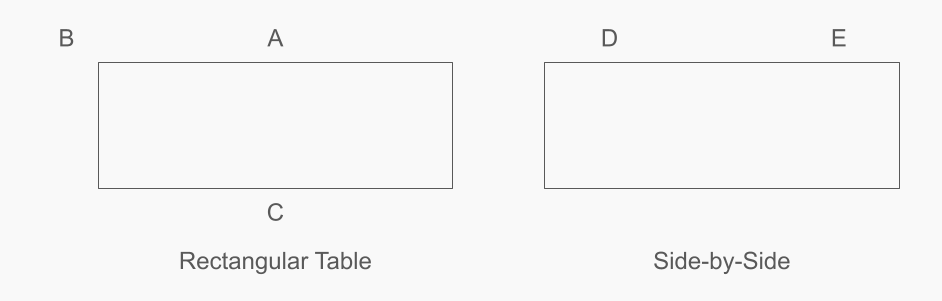
When working in a pair, there aren’t too many options to choose from. However, this makes your choice even more important. Let’s take the side-by-side seating arrangement for example. If you and your partner sit next to each other, you are basically setting up a collaborative environment. While this might work for compatible partners, it’s a risky gambit when working with a troll. You are essentially giving up any authority over the partnership.
You might look at the seating diagram and think that A-C seems like a perfect match! After all, sitting across from one another is quite common when working on a project. However, you would be gravely mistaken. This seating arrangement sets up a confrontational environment where neither you nor your partner has complete control. Since you can’t really see their screen, you can’t have them under your supervision. Rather, it spikes the tension and makes them put their guard up.
From decades of research, we have found that the optimal seating arrangement is A-B. Specifically, you MUST sit in the corner (B), tilting your screen diagonally. In effect, your partner cannot see your screen, while you can see everything they are doing. When they want to talk to you, they must physically reposition themselves, but you can simply talk straight ahead. These minor psychological cues condition them to see you as the leader rather than just another peer.
Group Seating Arrangement
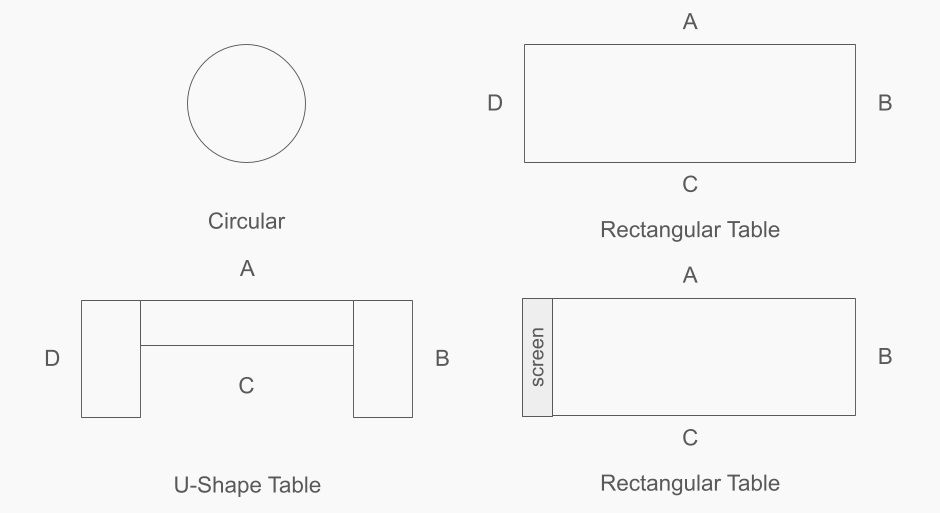
When working in a group, there are a few different options to choose from. Don’t panic. We have spent countless nights awake reasoning about every possible combination.
- Circular Table: This is perhaps the worst option to choose from if you want to take leadership of your group. In a round table, there is zero advantage for any member. In fact, you will get the same power as the laziest member of your group. If you choose this option, make sure to stock up on energy drinks, as you will be pulling many all-nighters trying to get the project done.
- Rectangular Table: In a rectangular table, there are two seats in particular that you want to aim for. You ideally want to sit in positions B or D. This is called the “Head of the Table”. The reason you want this position is because on the longer sides, many people sit next to each other, indicating that they are on the same level. However, if you are at the shorter ends, you are sitting by yourself, which creates a psychological divide. The one major issue with this seating arrangement is that there can be another person who is also sitting in the Head of the Table spot. This is dangerous, as that person might be seen as the one with authority if you don’t play your cards perfectly.
- U-Shape Table: The U-Shape Table is one of the best configurations for taking control of your team. You must prioritize positioning yourself in C. No matter where other people sit in this table configuration, they naturally face you. People in this position tend to also stand rather than sit, which gives the illusion that you have even more power. However, there are a couple of downsides. The primary one is that you might get physically exhausted being at the center of attention and having to stand for hours throughout the meeting. Also, keep in mind that this type of table is the hardest one to actually find.
- Rectangular Table with Screen: In our research, we have concluded that this is the optimal choice for those who want complete control over their teammates. A rectangular table with a screen eliminates the problem that the regular rectangular table had (which is that there’s an extra Head of the Table position). Furthermore, you are in a direct line of sight of the screen, which naturally gives you more authority as you will likely be the one in control of said screen. If you are given the option of choosing this configuration, we would highly recommend arriving early to snipe the Head of the Table spot.
Step 3: Use Facts to Make Your Argument Impossible to Refute
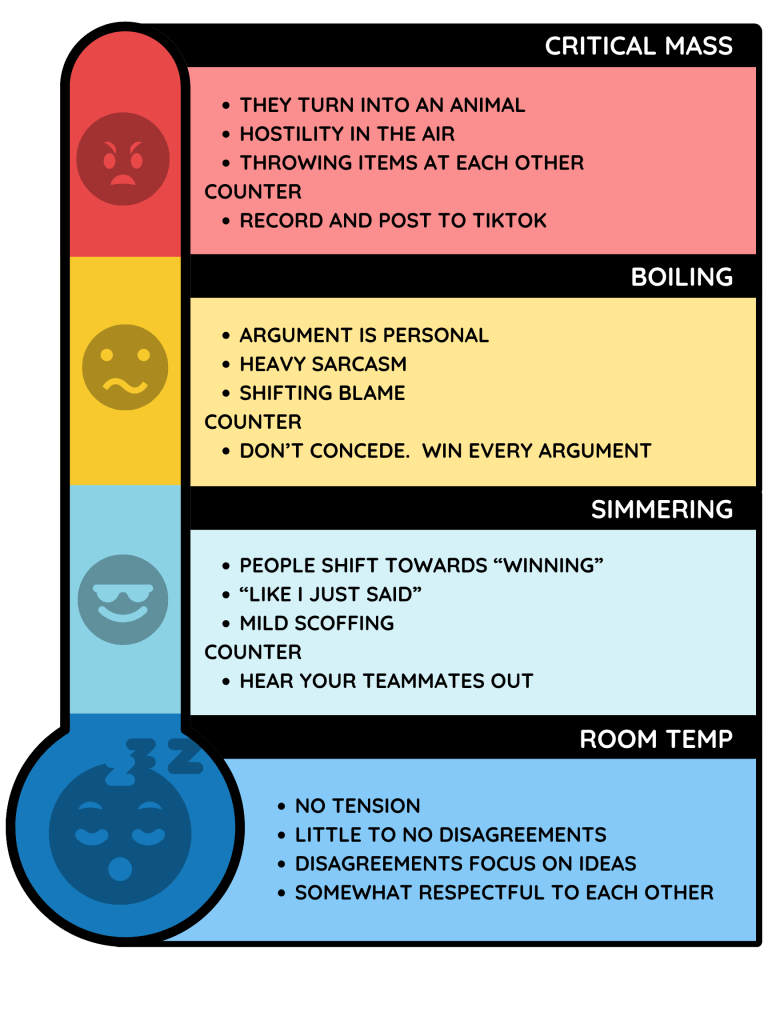
Thermometer demonstrating the different levels of tension in a group argument
At this point, you have compiled all the evidence and decided on the perfect meeting spot. Here’s a step by step breakdown on communicating with your peers:
- Take a deep breath. It’s not a big deal, buddy.
- Remember that you have all the evidence against your teammates. You do not need to worry about any counterarguments.
- Call out their names and list out all your grievances against them. Make sure that they are primarily evidence based rather than emotional.
One of the biggest mistakes people make is letting their emotions take control over them. When you let your emotions loose, you instantly lose the argument. In order to counter this, check the thermometer to see how to react. If you feel extremely angry, feel free to take a step outside and vent your frustrations. However, when interacting with your teammates, you must convey your arguments with logic.
Step 4: Challenge Absurd Ideas Without Questioning Your Teammates’ Intelligence
During the meeting, your teammates may suggest an idea so senseless that it makes you physically recoil. Unfortunately, telling them that their logic is stupid doesn’t resolve any arguments (in fact, it probably does the opposite). In this kind of situation, we must employ a different strategy known as the Self Checkmate.
Instead of explaining this idea, let me provide you with a couple of scenarios:
Scenario 1
One of your teammates proposes that the group should redo the entire presentation one day before everyone has to present. Instead of reassigning the responsibilities and listening to the infeasible ideas, you can respond with the following:
- “Great idea! When can you have it done by?”
- “I love the initiative. Hey, listen, don’t let us hold you back. I believe in you.”
- “If that’s the case, I know you’ll be really tired from pulling an all-nighter tomorrow, so I just want to make sure it’s clear that you have to show up to the presentation and present with us.”
Scenario 2
Your group is working on connecting a drone to a laptop, but you’re running into version compatibility issues. A teammate has the genius idea that the group should stop using Linux for the project, and instead should code up a custom OS. Here’s a few examples of responses:
- “Honestly, why stop at redesigning the OS? Why don’t we start from scratch, by smelting our own copper and creating our own chips?”
- “Oh, that’s perfect. Let me just email the professor real quick. I’ll let them know that the drone won’t be flying this semester, but stay tuned for your custom OS.”
- “I love your initiative. Can you get the bootloader, scheduler, and hardware interface done by tomorrow? While you do that, we will update the Python version and go sleep.”
Step 5: Become the Group Leader By Assigning Responsibilities First
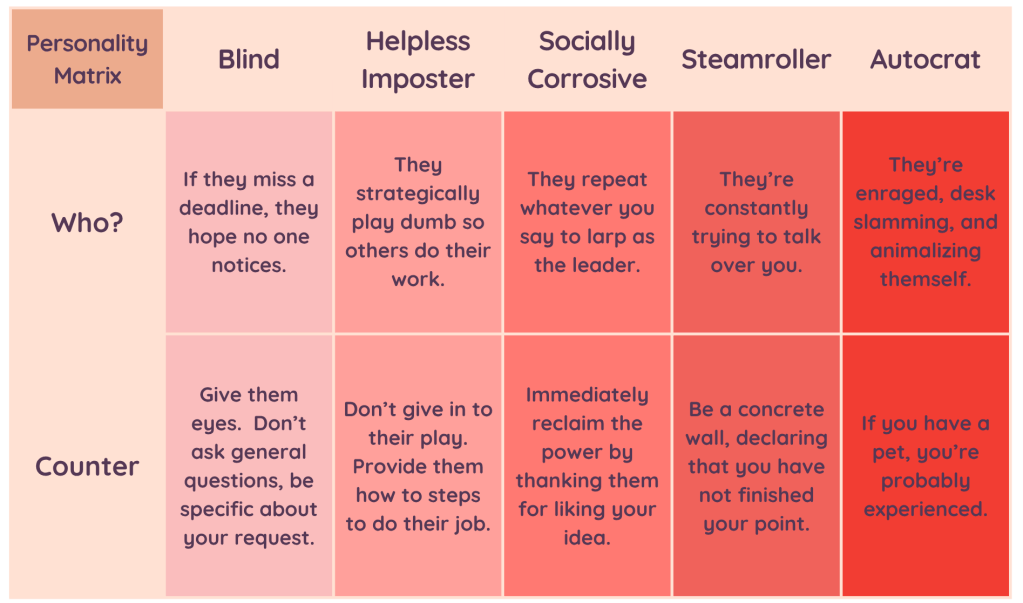
Personality matrix demonstrating how to assign work for different types of people you might encounter
This is perhaps the simplest step. If you fail this, you might be the blockhead. If you followed our steps well, you should have successfully established control of the team. All you need to do is call out each team member’s name and say what they need to do. Use the personality matrix above to figure out how to handle certain “types” of people. Don’t make the mistake of talking to a wall. Make sure you get a verbal confirmation that they have agreed to complete their assigned task.
Step 6: Have Every Agreement Written Down Before Someone Changes Their Story
People tend to have selective amnesia, where they “forget” what was assigned to them. You might ask your teammate to complete the slides by Wednesday. When Thursday rolls around, you’ll realize that the slides haven’t even been created yet. If you ask your teammate what happened, they may respond saying that they thought you meant the following Wednesday (essentially putting the blame on you), even though the entire project is due on Friday.
The best way to avoid this is to simply have a written record of every single agreement. This is when the group chat shines. If you have a written record of what each of your teammates agreed to, you can simply provide this evidence to your professor when they fail to do their tasks.
Step 7: Track Down Teammates Who Have Mysteriously Disappeared
All of our steps above fail if there’s a teammate who is secretly a phantom. They never open up their phone, check their messages, or even show up to the class. By the way, being inactive for an hour doesn’t make them a phantom…
The primary thing to do is to determine whether they are a phantom or a professional leech. Do they disappear in the moments you need the most? Are they always active on Instagram, but the moment you reach out, they go offline? Do they pick up when you call using a new number, but instantly hang up when they hear your voice? These are all clear indications that they are a professional leech.
Now, how do we deal with a professional leech? These leeches need a timebomb. If they don’t finish their work, they will blow up. For example, you can message your teammate and be explicit with the time they need to complete their work by, such as: “Make sure you finish your part by 11:00 PM tonight. If it’s not completed by then, don’t be surprised when your name is not on the final deliverable.”
If you’re ruled out that your teammate is indeed NOT a professional leech, there is only one remaining possibility. They are truly missing. You must act fast, as this is a life or death situation. Don’t hesitate. Immediately call 1-800-THE-LOST to report them missing. If the authorities ask for the situation, be sure to provide all the evidence you have compiled earlier in this guide.
If they truly were not missing, this will be a massive wakeup call. It will make them realize how serious their actions were (also 90% of the time, they are truly missing so don’t hesitate and call that number). After they’re found, don’t feel bad about removing their name from the final deliverable. After all, they have done nothing (even if they were abducted or held ransom).
There is a very real chance that they are not found. In this case, you should step up. You’re not just their group leader. You’re the only one who cares enough about their disappearance.
For more details, visit this How To article: https://www.wikihow.com/Find-Someone
Conclusion
Winning an argument is not about crushing your teammates ego. It’s about eliminating the scenario where you are cramming to get the work done last second because they all flaked on you.
We have distributed this guide to countless lost souls, and each of them were able to successfully command their teammates and get the project done. You too will have the same experience. One word of caution though: make sure your teammates don’t find this first.


Leave a Reply