

Credit Cards 101 for GT Students – Points, Perks, and a Good Credit Score
Written by by CJ and Vivian
Credit cards can seem confusing or even risky, especially for students who are using credit for the first time. Through this guide, we aim to help Georgia Tech students understand how credit works in America and how credit cards can be used as a tool to build a strong financial future.
Table of Contents
Understand What Credit Cards Are
What is a debit card?
What is a credit card?
Choose the Right First Credit Card
Student credit cards and other beginner options
Apply for Your First Credit Card
Gather information for your first application
Check for an annual fee
Use Your Credit Card Responsibly
Make smart purchases
Track your utilization
Earn Rewards and Perks
Compare cash back, points, and miles
Earn sign-up bonuses
Use purchase protection and other built-in benefits
Understand Credit Card Billing Cycles
Learn what a billing cycle is
Know the statement closing date and the due date
Compare your statement balance and your current balance
Pay in full instead of paying the minimum
Set up autopay and alerts
Build and Protect Your Credit Score
Learn why your credit score matters
Keep your credit score high
Manage credit utilization: how much of your limit to use
Summary
Understand What Credit Cards Are
What is a debit card?
Think of a debit card as a window into your checking account. When you swipe, the money leaves your account within a day or two. You can spend only what you have, so you cannot go into debt. The catch is that a debit card does not build credit history.
What is a credit card?
A credit card lets you borrow money from a bank and pay it back later. If you pay on time and in full, you owe no interest. Each on-time payment gets reported to the credit bureaus, and that builds your credit history. A good history helps you rent an apartment, finance a car, or buy a home down the road.
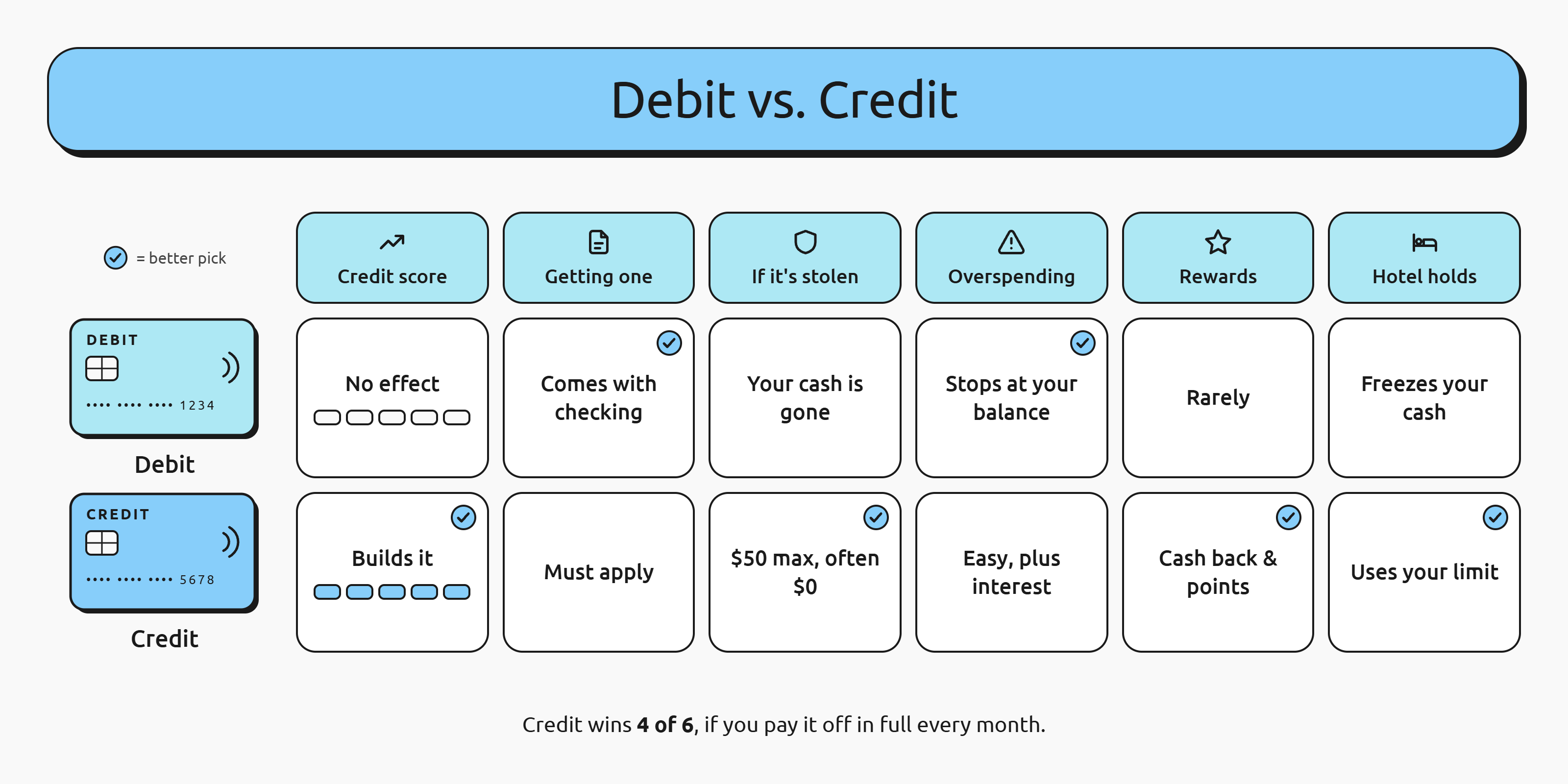
Credit cards can do a lot more than what debit cards do, including building a credit score, giving you cash back, and more!
Choose the Right First Credit Card
Student credit cards and other beginner options
You have a few friendly options for a first card. Student cards have lower approval standards and often skip the annual fee. Secured cards ask for a refundable deposit that becomes your limit, so approval is easier. You can also become an authorized user on a parent’s account. Compare the rewards, fees, and interest rates, then use the flowchart in the infographic below to find your match.
Apply for Your First Credit Card
Gather information for your first application
Your application asks for some basics: your full legal name, address, date of birth, Social Security number or ITIN, and income. Good news for students: you can count scholarships, grants, part-time pay, and allowances as income. Try the issuer’s pre-approval tool first. It uses a soft inquiry, so it does not touch your score. A full application triggers a hard inquiry, so apply for one card at a time.
Check for an annual fee
Some cards charge a yearly fee for holding them. Premium travel cards can cost hundreds of dollars a year, and a student rarely gets that value back. Start with a no-annual-fee card. You can upgrade later, after your income and habits grow.
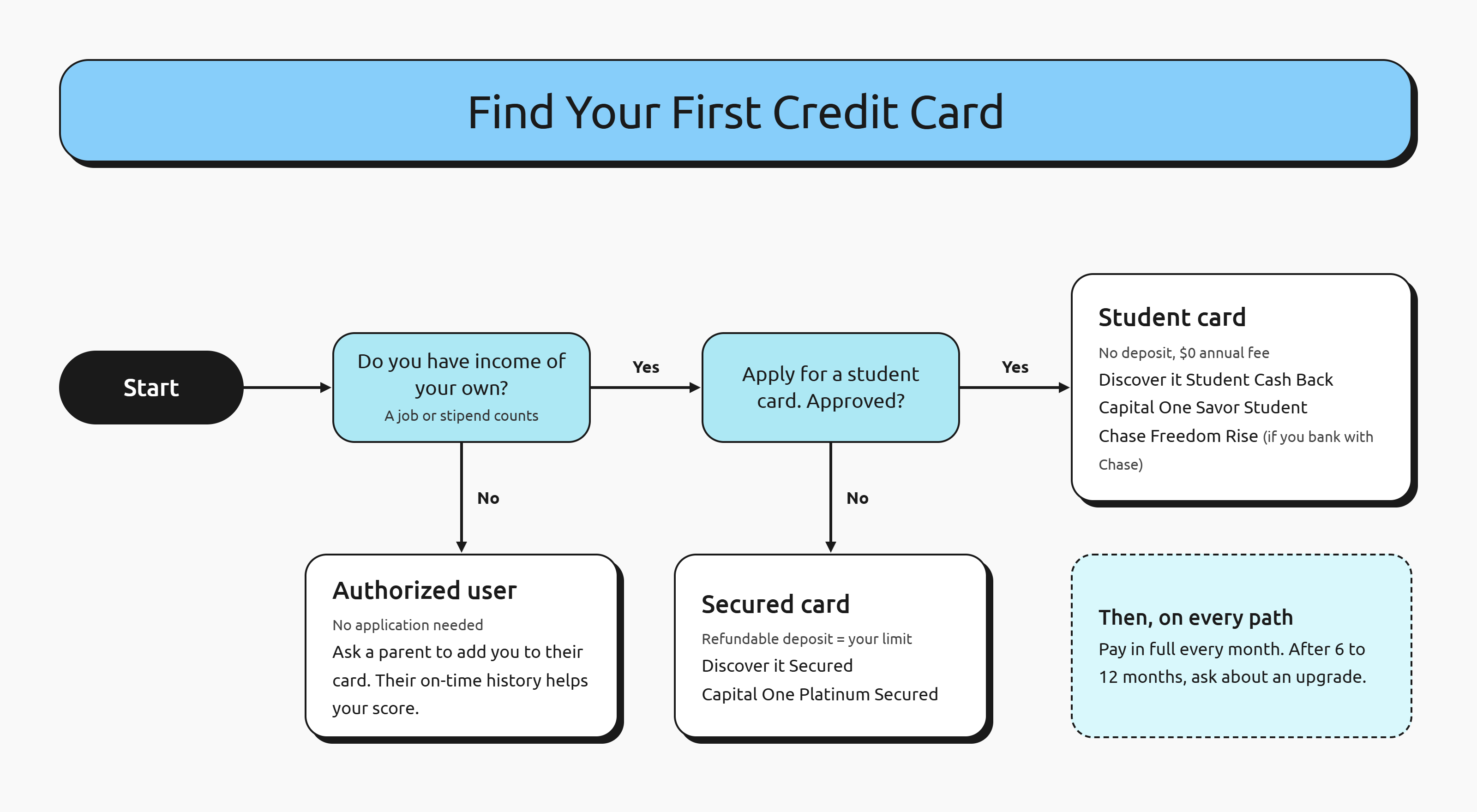
Applying for your first card and practicing using it responsibly is the first step you should take to start building credit!
Use Your Credit Card Responsibly
Make smart purchases
Treat your credit card like a debit card. Charge what you can pay off this month, like groceries, gas, or a streaming subscription. Skip big purchases you cannot cover when the bill arrives. Good habits keep interest at zero and build your credit at the same time.
Track your utilization
Utilization is the share of your credit limit that you use. With a $1,000 limit and a $300 balance, your utilization is 30%. Try to stay under 30%, and under 10% if you want a top score. Check your balance often so one big purchase does not push you over.
Earn Rewards and Perks
Compare cash back, points, and miles
Cash back gives you a percentage of each purchase as money. Points add up to rewards like gift cards, travel, or statement credits. Miles go toward flights and hotels, which suits people who travel a lot. For most of us, cash back wins because it needs no redemption system to learn.
Earn sign-up bonuses
Many cards give you a bonus when you spend a set amount in the first few months. Read the spending goal and the deadline before you apply. Plan purchases you already need, like textbooks and groceries, to hit the goal. Do not overspend to chase a bonus, because interest can wipe out the reward.
Use purchase protection and other built-in benefits
Credit cards come with protections that debit cards often lack. Fraud protection limits what you lose on unauthorized charges, and many cards extend warranties or cover damaged and stolen items for a limited time. Some also cover rental cars and offer price protection. Read your card’s benefits guide to see what you already have.
Understand Credit Card Billing Cycles
Learn what a billing cycle is
A billing cycle is the stretch of time, about 30 days, that your issuer uses to add up your purchases. When the cycle ends, you get a statement that lists your charges, payments, and balance. Then a new cycle starts.
Know the statement closing date and the due date
The closing date is the last day of the cycle. The due date comes about three weeks later, and it is your payment deadline. Miss it, and you pay a late fee, and your credit score can take a hit. Put both dates in your phone calendar.
Compare your statement balance and your current balance
Your statement balance is what you owed on the closing date. Your current balance adds every purchase and payment since then. Pay the statement balance by the due date, and you pay no interest on those purchases.
Pay in full instead of paying the minimum
The minimum payment is the smallest amount the issuer accepts, and it keeps your account in good standing. If you pay only the minimum, the rest of your balance grows with interest, and card rates often top 20%. Pay the full statement balance each month, and you owe the bank nothing extra.
Set up autopay and alerts
Autopay sends your payment on the due date, so you never miss it. Set it to pay the full statement balance, not the minimum. Turn on text or email alerts for due dates, big purchases, and balances near your limit. These tools protect your credit when midterms take over your life.
Build and Protect Your Credit Score
Learn why your credit score matters
Your credit score is a three-digit number from 300 to 850 that tells lenders how likely you are to repay debt. Landlords, auto lenders, mortgage lenders, and some employers check it. A higher score means more approvals and lower interest rates. On a 30-year mortgage, that gap can add up to tens of thousands of dollars.
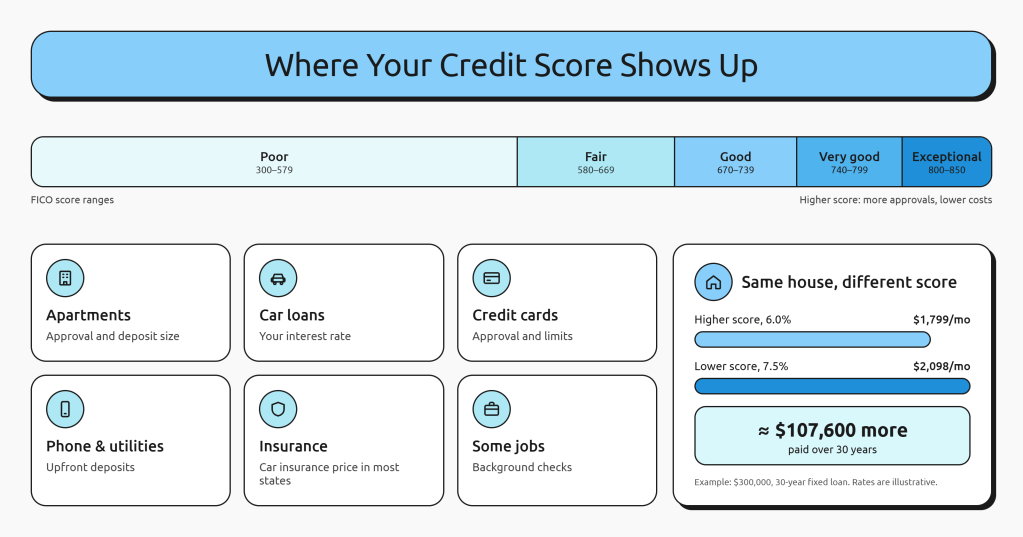
You should aim to keep your credit score as high as possible, as it could save you a lot of money on houses, loans, and utilities in the future!
Keep your credit score high
Five factors shape your FICO score: payment history, amounts owed, length of credit history, new credit, and credit mix. Payment history and amounts owed carry the most weight. Pay every bill on time, keep your balances low, and keep your oldest account open. Check your credit report for free at AnnualCreditReport.com to catch errors.
Manage credit utilization: how much of your limit to use
Lenders like to see you use a small part of your available credit. Keep your utilization below 30% on each card and across all cards combined. You can lower it by paying your balance before the statement closes or by asking for a credit limit increase. Low utilization tells lenders you handle borrowing well.
Summary
We hope that this guide was helpful in getting you started with your first credit card and made the process seem less scary than it actually is! A credit card is one of the easiest tools you have to build your financial future, as long as you use it with care. Start with a beginner-friendly card, pay the full statement balance on time every month, and keep your utilization low. Build these habits now, and by graduation you’ll have a credit history that opens doors to your first apartment, car, and beyond.


Leave a Reply