

A Guide on Active Recall, Spaced Repetition, and AI Tools for Busy Georgia Tech Students
Written by Emiko Jones and Jad Matthew Bardawil
Learn how to study smarter, retain information longer, and make the most of your limited time with practical, research-backed study strategies and AI tools designed for Georgia Tech’s demanding academic environment.
Table of Contents
Why This Guide Matters
Plan Your Time
Step 1. List Your Fixed Commitments
Step 2. Choose What Deserves Attention First
Step 3. Reserve Realistic Study Blocks
Make Studying Active
Step 4. Recall Before Your Reread
Step 5. Revisit Material Across Several Days
Use AI with Intention
Step 6. Ask AI to Tutor You
Step 7. Test Yourself Without AI or Notes
Keep Improving
Step 8. Review Your Plan & Reset Each Week
Summary & Your Next Move
Resources and Further Readings
Why This Guide Matters
At Georgia Tech, having time to study and knowing how to use that time are two different problems. A packed schedule can make it tempting to promise yourself that you will study whenever a gap opens up. But when assignments overlap with practice, travel, work, or campus commitments, those gaps disappear quickly. Even when you sit down with your notes, it can be difficult to decide what deserves attention first.
This guide starts with that problem rather than assuming students need to study for longer hours. Its goal is to help you turn the time you already have into a routine you can repeat. First, you will map your commitments, identify the topics that need attention, and reserve realistic study sessions. Then, instead of only rereading notes, you will practice recalling information from memory and revisit it across several days. You will also see how an AI tool can help explain a confusing idea or generate practice questions without doing the thinking for you. The result is an eight-step process you can adjust each week. You do not need the same schedule as a student-athlete to use it. You just need your course materials, a list of commitments, and a willingness to test what helps you learn. When your week changes, your plan can change with it.
Plan Your Time
It is important to plan ahead when studying.
Step 1. List Your Fixed Commitments
Open your class syllabi, assignment lists, and calendar. Write down class meetings, practices, travel, work shifts, and personal commitments before adding any study time. Then mark upcoming due dates and exams. Treat this as a snapshot of your actual week, not an ideal week with unlimited free time.
Step 2. Choose What Deserves Attention First
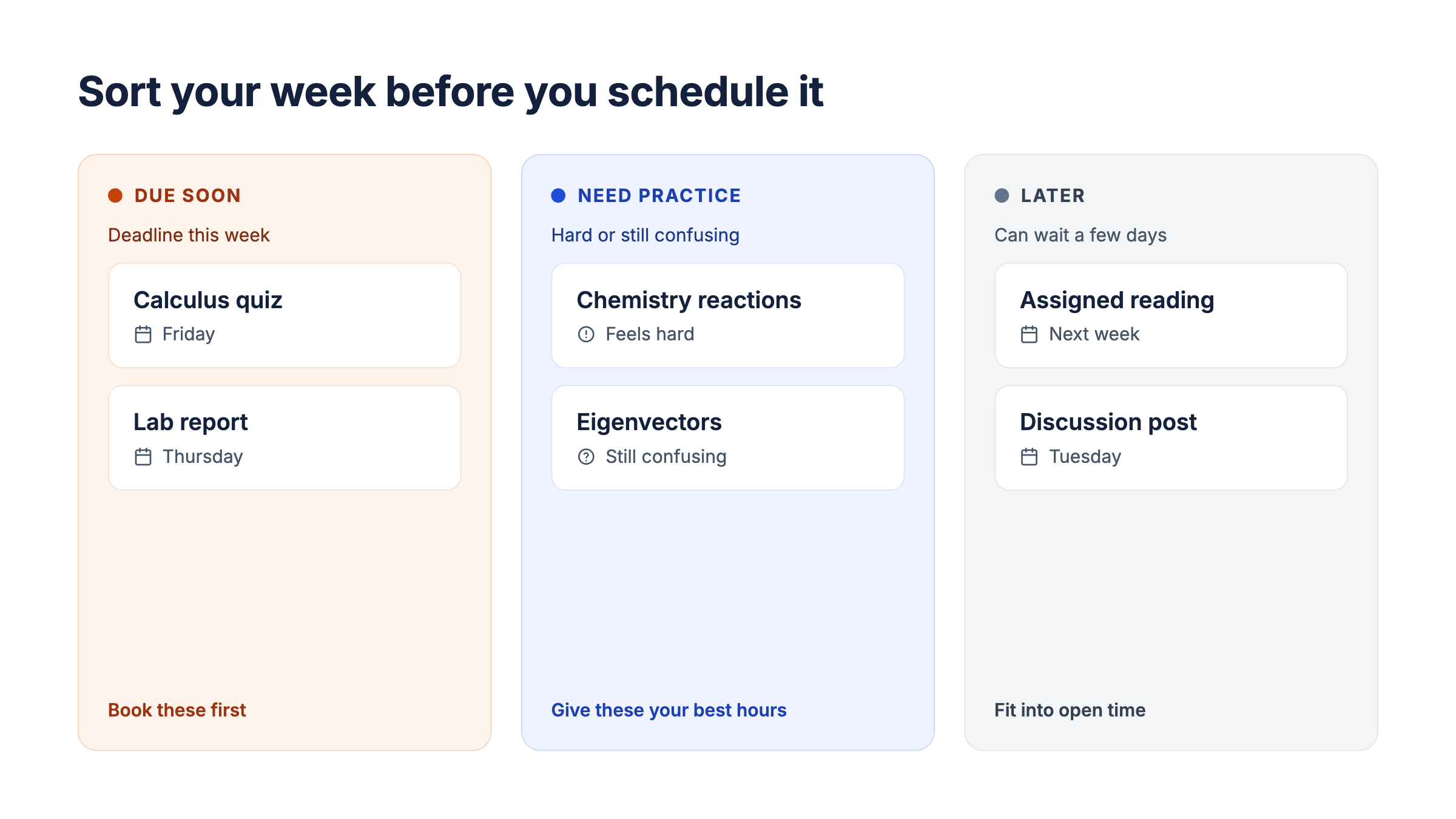
For each course, list the next assignment or topic you need to understand. Mark anything due soon and anything you cannot explain or solve without notes. Choose two or three priorities for the week. A difficult concept that appears on Friday’s quiz may deserve an earlier study block than an easy task due next week.
Step 3. Reserve Realistic Study Blocks
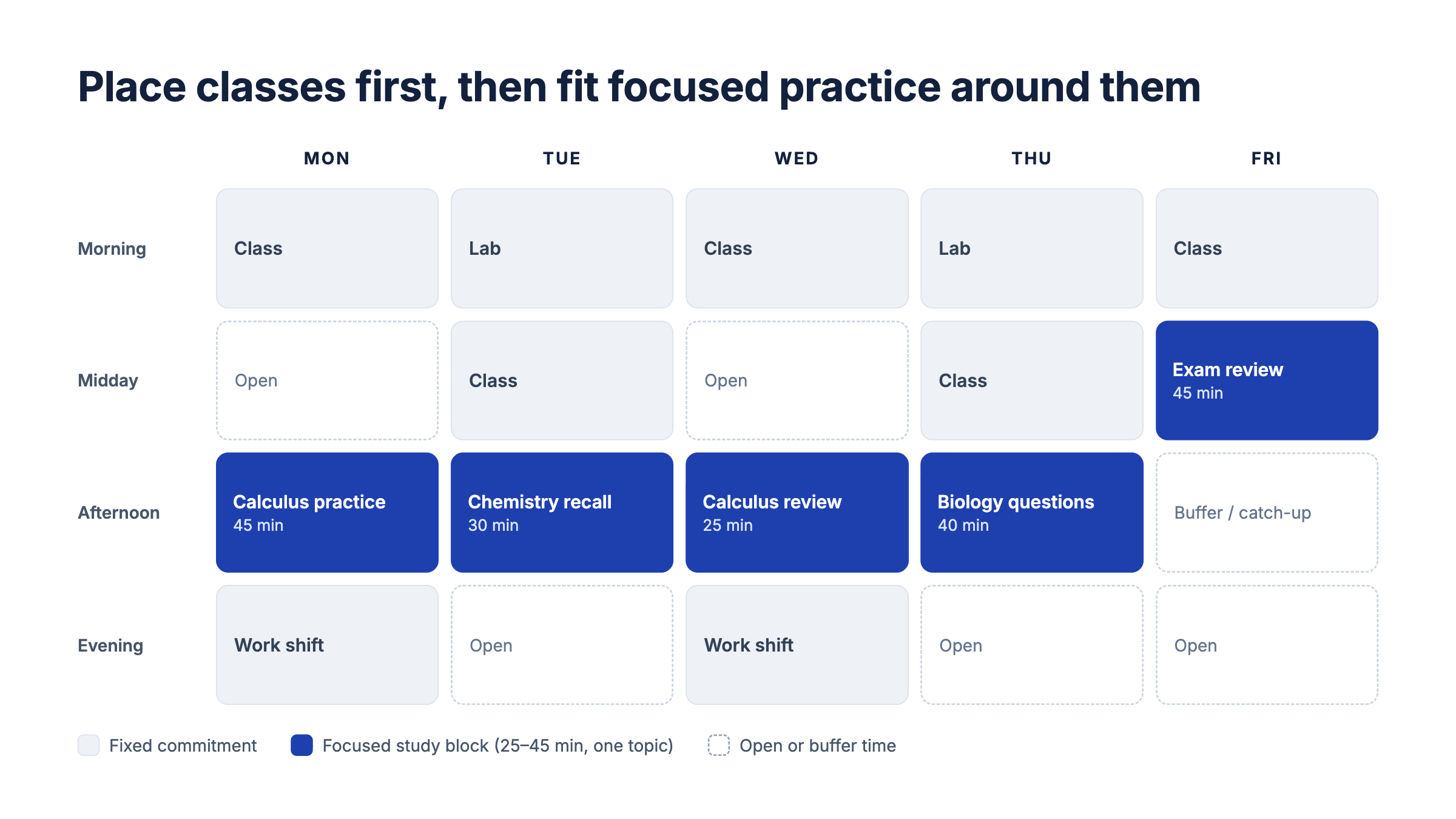
Find several open windows in your calendar, even if they are only 25 to 45 minutes long. Give each window one specific purpose, such as practicing derivatives or recalling biology vocabulary. Leave some space for food, travel, and unexpected changes. If practice runs late, move a block rather than abandoning the entire plan.
Make Studying Active
There are several ways to make your studying more effective.
Step 4. Recall Before You Reread
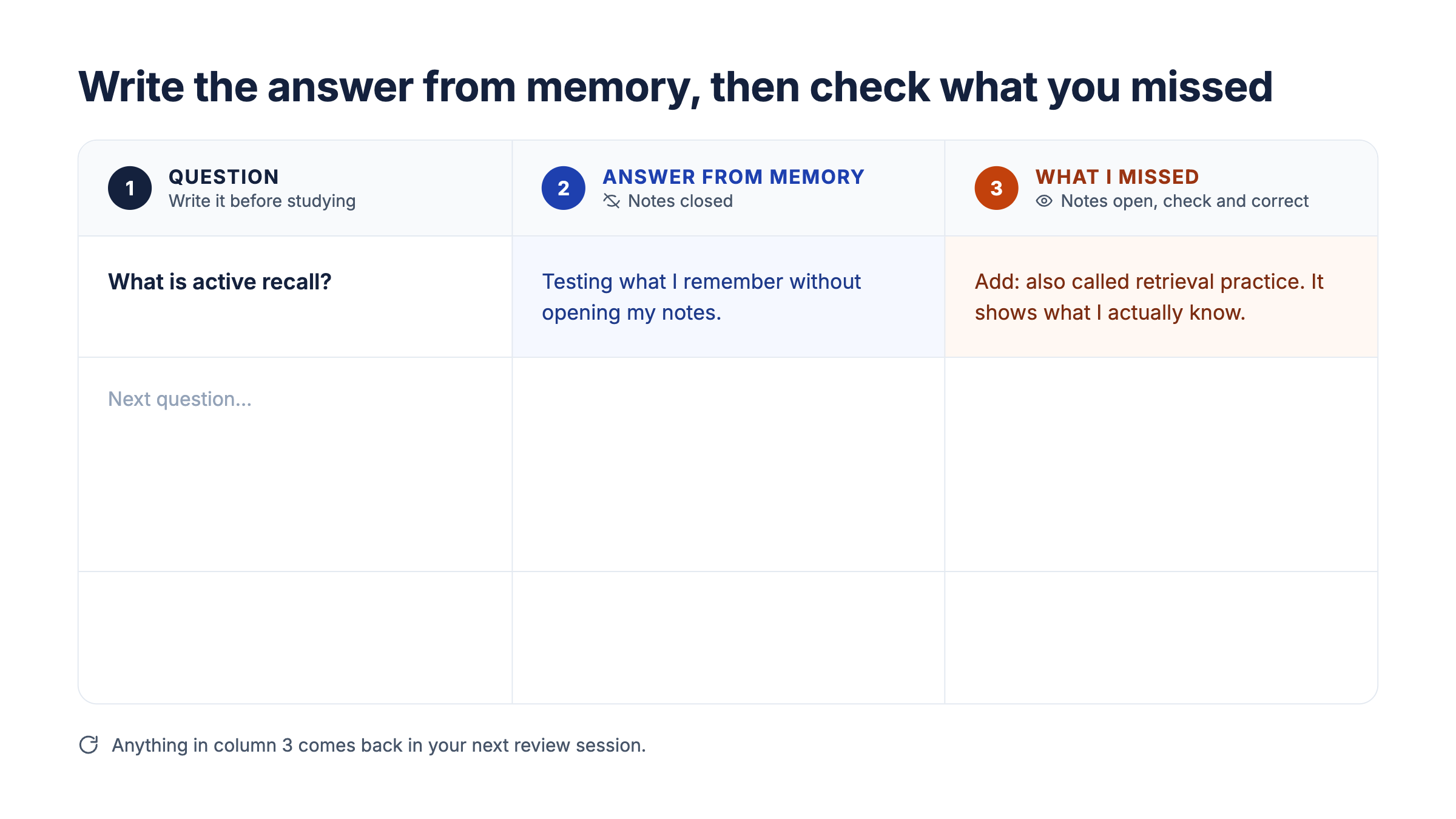
After reviewing a topic briefly, close your notes and write down what you remember. Work through a problem from scratch, explain an idea out loud, or answer practice questions without looking. Then reopen the material to find the gaps. This is active recall, often called retrieval practice, and it helps you identify what you actually know.
Step 5. Revisit Material Across Several Days
Do not save every review session for the night before an exam. Return to the same topic in shorter sessions across the week. For example, learn a concept on Monday, retrieve it on Wednesday, and test it again on Sunday. Spend the most time on material that remains difficult instead of repeating what already feels familiar.
Use AI with Intention
AI can be a great study tool when used right.
Step 6. Ask AI to Tutor You
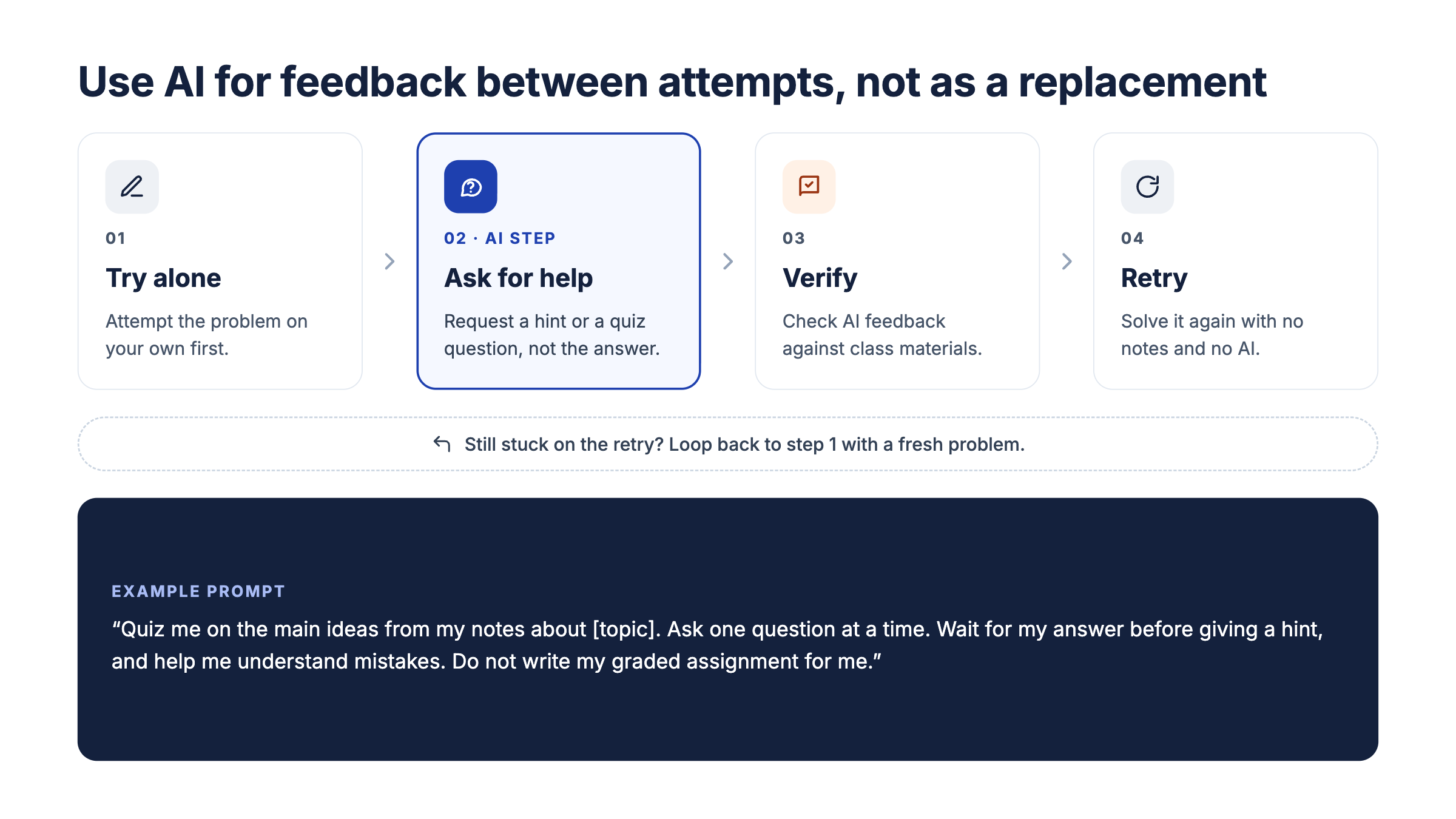
Check your instructor’s AI policy before using any tool. For permitted studying, ask the AI to explain a concept in simpler language, give hints, or quiz you one question at a time. Try: “Quiz me on [topic]. Wait for my answer, tell me what I missed, and explain how to improve.” Check its responses against your course materials.
Step 7. Test Yourself Without AI or Notes
End a study session with a short, independent check: solve one fresh problem, answer five questions, or summarize a lecture from memory. Sort your results into “know,” “almost,” and “need help.” Add the last two categories to your next review. If a concept is still unclear, ask a TA, professor, tutor, or academic coach.
Keep Improving
There is always room to grow.
Step 8. Review Your Plan & Reset Each Week
At the end of the week, look at what you finished, what took longer than expected, and what you still cannot explain. Move unfinished tasks into the next week and adjust study blocks around new commitments. Keep the techniques that worked. Change the parts of the routine that did not, rather than treating one busy week as a failure.
Summary & Your Next Move
You don’t need to set all of this up at once. This week, pick the class that’s stressing you out the most and find two times you could study for it. When you sit down, close your notes and try to answer a few questions before you look anything up. If you get stuck, ask AI for a hint, then check it against your notes or textbook. On Sunday, look at what actually happened and change next week’s plan to match.
Resources and Further Readings
Study Strategies
UCSD Psychology / Retrieval Practice
Effective Study Habbits
UCSD Psychology / Spaced Practice
Academic Resources Available to GT Students
Georgia Institute of Technology / Academic Coaching
AI Use at GT
Georgia Tech Office of Information Technology / Academic Guidance for Generative AI


Leave a Reply