

By Soham Shetty and Shrutee Behera
Introduction
While many students decide to accept a job offer and begin working immediately after graduating, there are still a substantial number of undergraduates who pursue alternative routes, including post-graduate education. Often, students don’t know about all of the options they actually have, and by the time they learn about an opportunity they might be interested in, they may not have the preparation to pursue it. For instance, a student might find a graduate program they would consider, but not have enough time to study for the GMAT, GRE, or another standardized assessment because they did not know about the program sooner.
At Georgia Tech specifically, several opportunities are available for students to continue their education, such as OMSCS or the BS/MS pathway. However, the application process can look different based on the field a student is coming from or the program they are applying to. Requirements may vary, whether that means taking a standardized assessment, gaining research experience, submitting recommendation letters, or completing prerequisite coursework.
Creating a how-to guide specifically for Georgia Tech students would help organize these options and their application processes. Showing students the options they actually have and providing guidance about the application process itself will help them decide what to pursue after graduating while also planning the logistics and finances.
Table of Contents
- Define your long-term career/academic goals
- Research your post-graduate options
- Work on your Grad school Application timeline
- Network with fellow Upperclassmen
- Get the required number of faculty recommendations
- Look into and take required assessments pertaining to post-graduate studies
- How to finance your post graduate education
- Summary
STEP 1: Define your long-term career/academic goal
Before deciding on a specific post-graduate program, it’s important to identify what your long term goals are within your career in order to see if a specific post-graduate program would help you achieve those goals. For instance, a student who graduates with a bachelor’s degree in computer science might decide that their long term goal is to move into a more managerial role at whichever firm/company they decide to work for. This could mean pursuing an MBA would help them readily make that pivot from traditional software engineering. Pinpointing what you would like your career trajectory to look like will help you understand if investing in post-graduate studies will be worthwhile for you and can also give you an idea of the kind of program that might be a good fit.

STEP 2: Research your post-graduate options
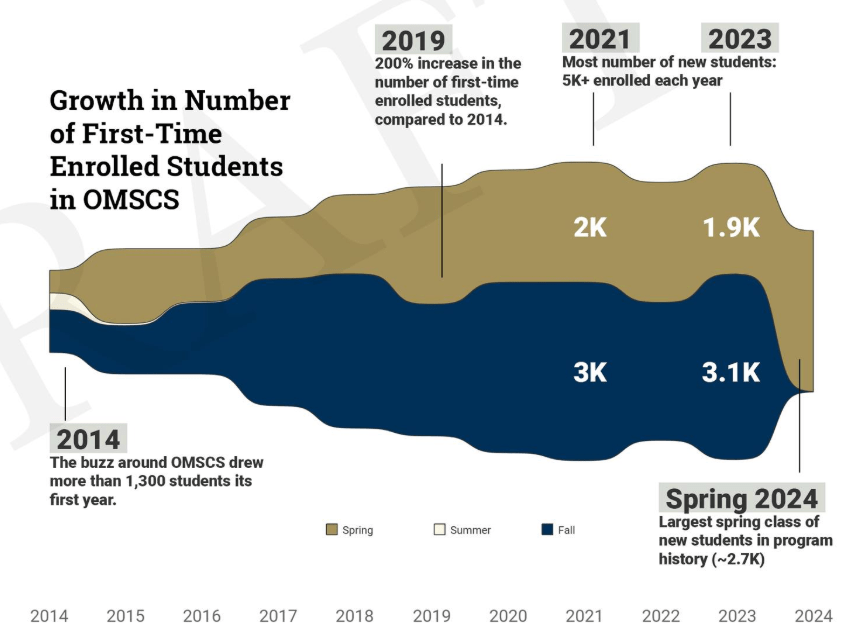
A crucial first step toward pursuing education after your undergraduate degree is deciding what type of post-graduate program you want to enroll in. For example, if you want to finish your master’s more quickly, you can look into Georgia Tech’s BS/MS options, which let students to double-count up to 6 credit hours toward both degrees. If you want to go into the workforce after undergrad while still pursuing a master’s, you can also consider GT’s OMSCS program, an online option that offers more flexibility. While requirements vary by program, it is important to conduct proper research to maximize your chances by attending GT’s Grad Expo ,speaking with faculty or department advisors, and reviewing the full list of GT graduate programs to determine the best option.
STEP 3:Work on your Grad school Application timeline
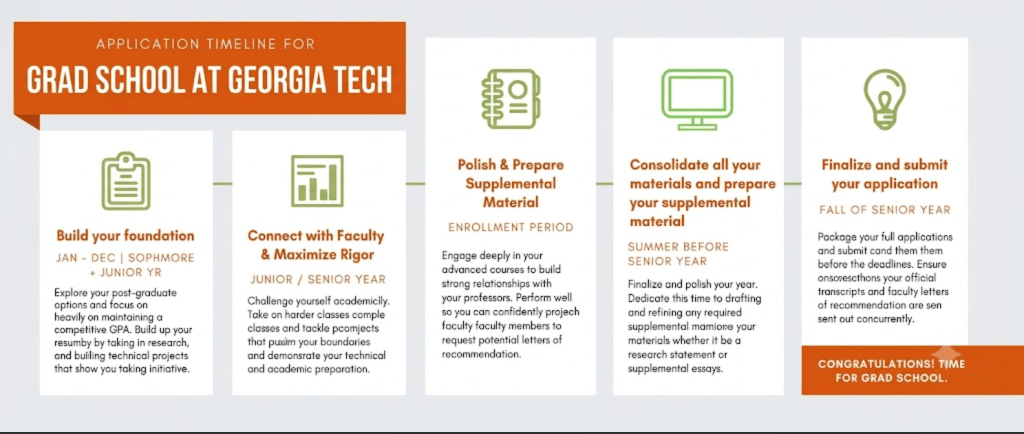
You would typically start planning out your grad school application process in the middle or later years of your undergraduate degree. You would start by exploring your post-graduate options and building a strong academic foundation while focusing on building your resume by taking part in research and internships. If you are in your junior/senior year then you must also showcase academic rigor by taking harder classes and working on complex projects. Additionally, you must also build a strong relationship with your professors for potential letters of recommendations. Typically, after taking a professor’s course and performing well, you can approach them to request a letter of recommendation based on your performance and engagement in that class. In the summer before your senior year, students should focus on finalizing and polishing their resume and working on any necessary supplemental application material required for their degree program. It is typical during the fall of your senior year that you submit your graduate school application and receive the results of your application by Spring. Use online resources like Purdue’s application timeline to plan your grad school journey.
STEP 4: Network with fellow Upperclassmen
Aside from researching online – one of your best resources would be to network with your fellow upperclassmen who are already enrolled in your desired program and get their insight on it. These upperclassmen can provide practical advice on the inner workings of the program, how to secure scholarship aid and how to make your application more competitive. Additionally, they can also point you towards other resources, recommend faculty connections and almost act as a “mentor” while you pursue your post graduate education. Connect with upperclassmen from your classes or student organizations. You can also network with alumni via GT’s LinkedIn page or attend GT’s Grad Expo to learn more.

STEP 5: Get the required number of faculty recommendations

The different post-graduate options at Georgia Tech have varying recommendation requirements. For instance, the BS/MS Computer Science pathway requires two letters of recommendation, with one from a Georgia Tech College of Computing faculty member and the second from any Georgia Tech faculty member. OMSCS requires contact information for three letters of recommendation from people who can speak to the applicant’s academic or technical ability. Requirements also differ outside of computer science. For example, Scheller MBA applicants need two letters of recommendation, while the MS in Analytics requires three. Because of these nuances, students should carefully check the specific recommendation guidelines for their program of interest and do this early enough to build relationships with professors or supervisors before application deadlines.
STEP 6: Look into and take required assessments pertaining to post-graduate studies
The different post-graduate options at Georgia Tech have varying assessment requirements. Some programs may require or accept the GRE, while Scheller options may require or accept the GMAT or GRE. The MS in Analytics requires GRE or GMAT scores, while OMSCS and the BS/MS pathway in Computer Science do not require the GRE. Students looking into medicine or healthcare pathways, like the Emory and Georgia Tech MD/PhD pathway, would need to take the MCAT instead. Because registering, planning, and studying for these exams takes time, students should identify which exams they need as early as possible.

STEP 7: How to finance your post graduate education
Pursuing postgraduate education can be expensive, but financial aid can help reduce costs through fellowships, scholarships, and assistantships. At Georgia Tech, options like the GANN Doctoral Fellowship and FACES Fellowshipare available. Students can also secure Graduate Research Assistant (GRA) or Graduate Teaching Assistant (GTA) positions, which may include tuition waivers. A GRA works in a faculty-led research lab, supporting projects, experiments, and publications, and is typically obtained by reaching out to faculty and showing relevant skills or experience. You can take a similar approach when trying to apply for a GTA position. A GTA position is essentially a TA position for a grad/undergrad class where you help the professor with their day to day tasks.
You can find more information on how to apply for a GRA or GTA position here.

Summary
Conclusion:
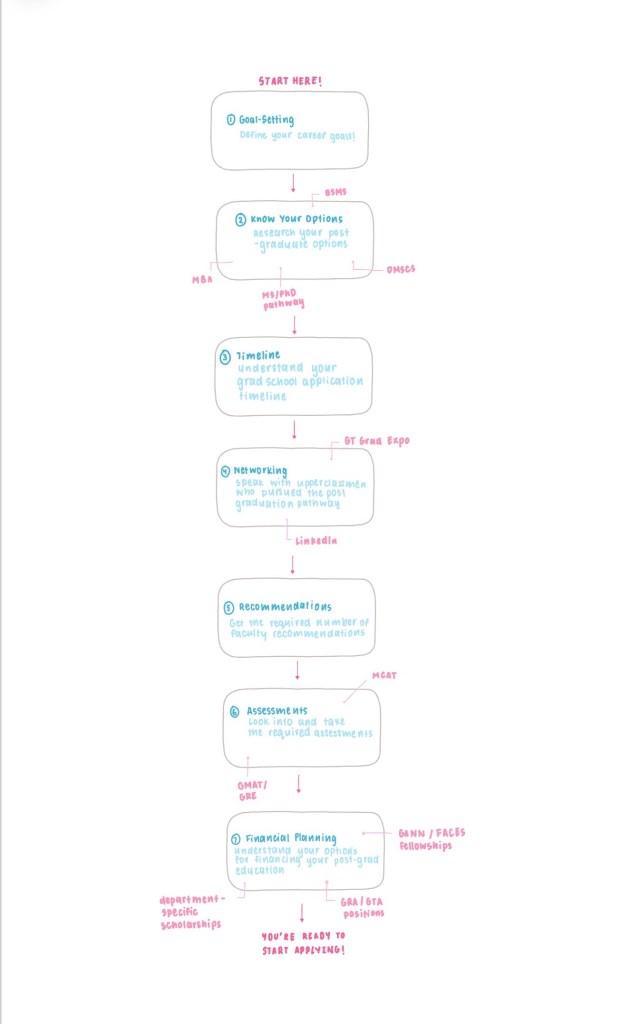
When mapping out post-graduate education at Georgia Tech, students need to consider their career goals, program options, application requirements, and financial planning. This guide summarizes the key steps involved in planning the application process so students can make more informed decisions about their academic paths after graduation and feel more confident navigating post-graduate opportunities at Georgia Tech.
Sources
- Georgia tech grad (www.grad.gatech.edu)
- Georgia Tech website (www.gatech.edu)
- Georgia Tech catalogue (www.catalog.gatech.edu)
 GT-How
Leave a comment