

By Yuv Rout and Kolinkar Roy
Table of Contents
- Table of Contents
- Introduction
- Step 1: Find the office hours schedule and format
- Step 2: Go before you are completely lost
- Step 3: Prepare your materials before you arrive
- Step 4: Turn confusion into a clear question
- Step 5: Join the line and set context quickly
- Step 6: Communicate clearly during the conversation
- Step 7: Leave with a clear next steps plan
- Step 8: Practice again the same day
- Step 9: Make office hours part of your routine
Introduction
Georgia Tech’s courses move at a very fast pace, and many students fall far behind on their assignments and their general comprehension of the material before realizing that assistance is available. Office hours are among the most valuable tools on campus. Students frequently avoid using this tool because they are unprepared and feel embarrassed. Some students wait the day before their test, when it’s much more difficult to get a space because of how crowded it is. This important college tool, which may help students absorb the course material much earlier and minimize long term stress, is frequently overlooked by students in general.
Instead of turning up during office hours unprepared with weak questions, this guide will teach students to make an efficient use of office hours. Students should be able to express their ideas properly to the professor or TA and learn how to effectively explain where they got stuck. In addition to meeting all of these criteria, this guide will give students a clear method for coming up with a plan for what to do after office hours. Students benefit from office hours because they provide a means of getting immediate assistance with the portion of the course that they find confusing. Because of this, office hours can help students develop better study habits and boost their confidence in the course material.
Step 1: Find the office hours schedule and format
Determining the time and location of office hours is the first step in this guide. The majority of courses have office hours included in their syllabus, which is accessible on the Canvas platform. While some office hours are conducted remotely via Zoom or another online platform, a significant portion are conducted in person. Make use of the first week of class to locate this information and save it in an easily accessible way.
It is very important in order to pay attention to who conducts the office hours to students. Office hours with a professor, office hours with a teaching assistant, or even additional aid sessions are offered in some courses. A certain choice will be far more helpful than another, depending on your question. For instance, if a homework assignment is difficult, a teaching assistant could be the ideal person to help. Speaking with a professor during office hours will be considerably more beneficial if there are a lot more general conceptual questions or guidance on how to approach the particular course. Putting these precise times and dates on your calendar in advance will make office hours seem like a regular resource, or you may use them as an unexpected alternative.
If you need additional help beyond office hours, Georgia Institute of Technology offers Tutoring & Academic Support resources that is able to help students stay on track with their courses.
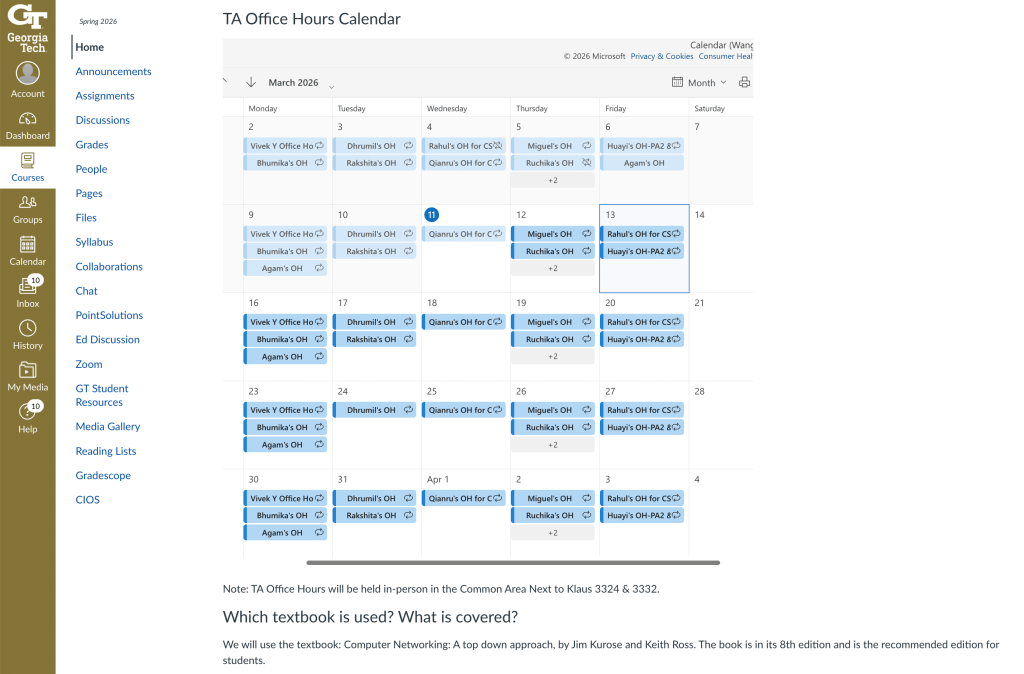
Source: Screenshot example from Canvas platform.
Step 2: Go before you are completely lost
Many students wait too long to ask for help during office hours. They only attend additional help after they miss a good amount of lectures or they do bad on assignments, or they start to panic a couple of days before an exam. By the point they reach office hours their confusion is often multiplied and more difficult to explain. A much more efficient approach is to go as soon as students notice confusion on a topic, or if they keep making the same mistake over and over.
Attending office hours earlier has a wide variety of advantages. First it’s going to be able to lower the pressure among the students as it does not try to fix so many problems at once. It will also make it less intimidating to go back again to office hours if students are using them for their normal study routine. If students go to office hours early it’s not considered overreacting however it is one of the smartest ways to stay on track within a difficult course.
Step 3: Prepare your materials before you arrive
A student should never arrive at office hours with a lack of preparation. They should bring their own notes, their work/assignment, or even a list of questions they had during the lecture. Even if the student’s work is incorrect, it still provides the TA with a great place to start to approach the problem. The student should spend at least ten to fifteen minutes working on the topic independently before coming to office hours.
Since office hours are the most helpful when the person instructing you can observe your whole thinking process, a student’s total preparation is undoubtedly important. It is much simpler to point to the location of confusion if students are able to directly point out the error within the student’s work. Making a list of the several objectives you hope to accomplish during office hours is also beneficial. This is due to the fact that entering with a purpose will result in a more focused discussion and enhance your study habits.
This kind of preparation is recommended by college support resources such as Cornell’s office hours guide, which advises trying the assignment, going over your notes, and figuring out what you don’t understand before you leave.
Step 4: Turn confusion into a clear question
The quality of the student’s question is one of the biggest distinctions between an office hours session that is unproductive and one that is productive. Students should attempt to pinpoint the precise point of uncertainty where their own comprehension of the material breaks down rather than claiming that they don’t comprehend anything about it. For example, the student could explain that while they comprehend a portion of the issue, they are unsure of the rationale for the application of a formula in that particular section. The student should ask more detailed inquiries if they want the TA to provide more helpful explanations.
A well crafted question from a student should contain the subject they are unsure about as well as any steps they could be puzzled about throughout their real effort at the task. This provides sufficient background for the person replying to them to provide a clear and relevant response. Even if the student is really perplexed about much of the content, it will be simpler for them to receive the assistance they require if the overall uncertainty is divided into smaller parts. The best way to use office hours is to ask a target question instead than beginning with a general annoyance.
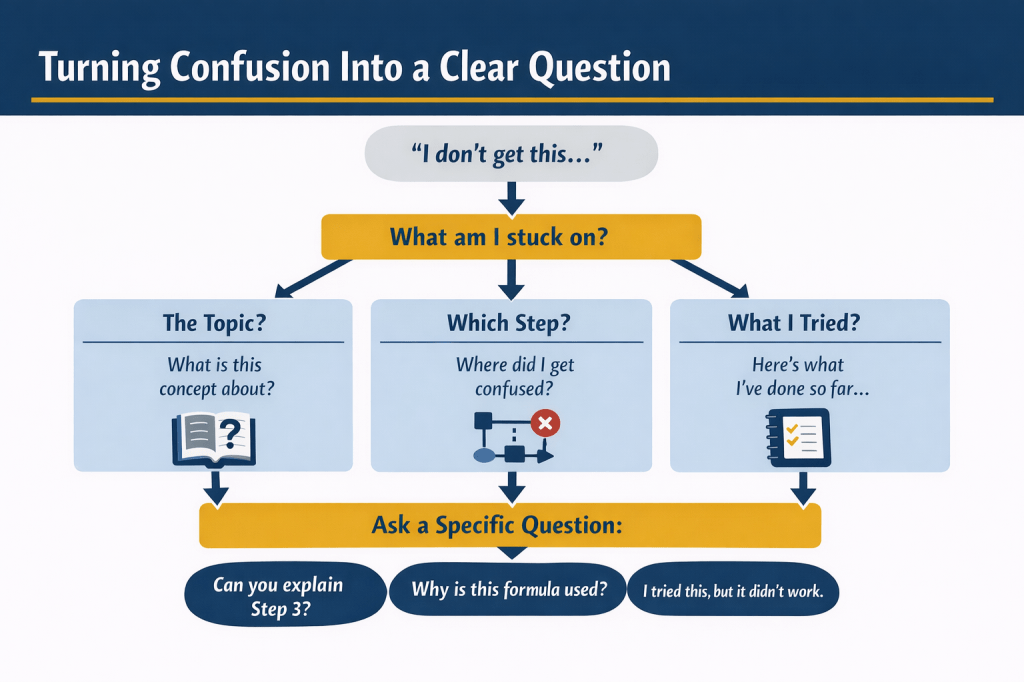
Infographic created by Yuv Rout and Kolinkar Roy
Step 5: Join the line and set context quickly
The student will only be given a few minutes at a time if office hours are hectic. This implies that individuals need to be able to quickly and clearly convey their concerns and questions. The individual should begin by identifying the particular subject they are concentrating on and demonstrating where they are stuck. This shows the TA that they have previously attempted to answer the question. This makes the work session more productive and gives the teacher a fair bit of background.
Step 6: Communicate clearly during the conversation
It is crucial that these students comprehend the approach that is taught office hours rather than only getting the solution. If the student’s knowledge is still uncertain, they should be ready to ask a variety of additional questions. They shouldn’t be scared to request better next actions or another explanation. Instead of only knowing what to write down in their notes, the student should leave office hours with a deeper comprehension of why the approach works.
Additionally, this is the ideal moment for the student to be open about what they understand and what they don’t. They should attempt to explain their own steps if the explanation begins to make sense gradually. The student should confront the TA if they are still having trouble understanding the material. Students can learn during office hours, and it’s common for them to need further clarification even more than once. Students should also approach the lesson with an attitude of active learning.

Source: Georgia Tech Student Center – Campus Jobs.
Step 7: Leave with a clear next steps plan
Students should make sure they know what to do beyond office hours. They should ask themselves what caused the uncertainty in the first place and go over it again later, paying particular attention to the difficulties they should practice next. To develop improved study habits, the student should undoubtedly write down one or two action items before leaving office hours.
A successful visit during office hours gives the student more than just a sense of relief. When the student leaves, they should know which ideas to review and which instances to attempt again. In order to make sure they grasped the explanation in the most effective and accurate way, students should verify with the professor or the TA.
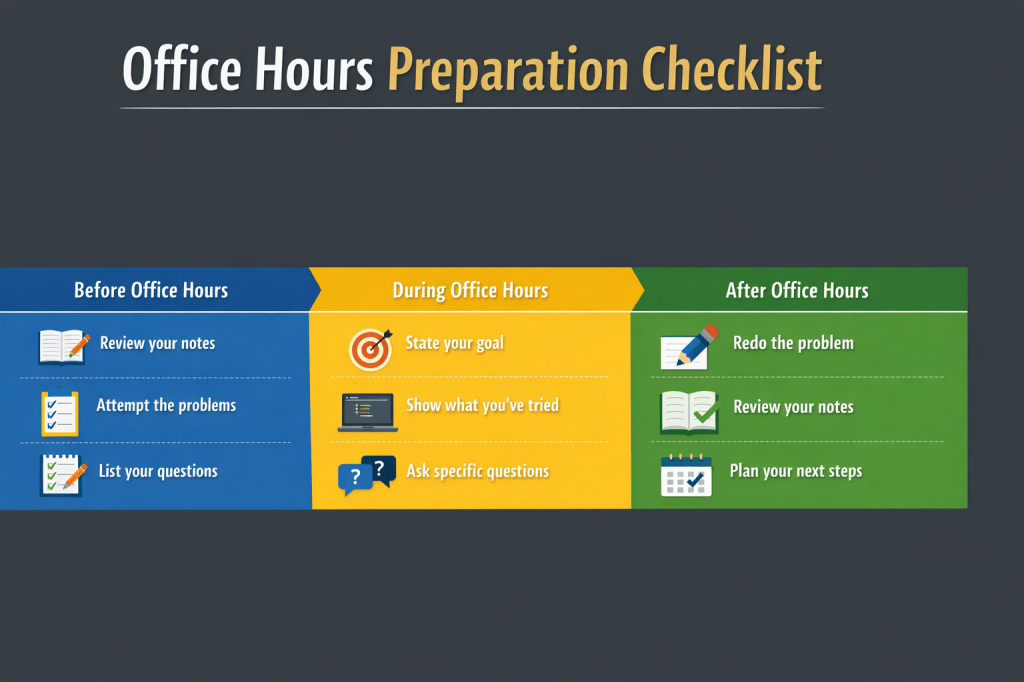
Infographic created by Yuv Rout and Kolinkar Roy
Step 8: Practice again the same day
Later that day after the office hours session, the students should tackle the same issue again, or at the very least, try to answer a problem related to the same subject without heavily depending on their own notes. This enables the student to determine whether they actually grasped the idea and the method for successfully solving it. In this step, the student shouldn’t require any assistance, and they should put new questions in their notes for the next office hours visit. These stages are crucial since being able to comprehend information during office hours is not the same as being able to independently interpret it. Students can assess their comprehension of the material by reworking the issue or other problems on their own. It is a positive and significant indication that they are making progress in the course if they can solve difficulties in their own style and explain concepts in their own terms.
Step 9: Make office hours part of your routine
Office hours are ideal for students who use them often, not simply during emergencies. Office hours are beneficial to students even if they are not in class. A student who regularly attends office hours might eventually gain confidence and ask more challenging course questions. This will enable them to identify minor mistakes before they become significant over time.
The student can begin to consider office hours as one of many academic resources offered by Georgia Tech, much as attending lectures for class study and going over notes, rather than as a last resort. In the long term, a student’s ability to manage the balance of several classes throughout their semester will be significantly improved by this mental adjustment.
At Georgia Tech, building office hours into your routine can also mean combining them with drop-in tutoring, including assistance for courses that are in high demand, like the CS Help Desk in Clough.

Source: Inside Higher Ed, “Making Office Hours Matter”. Image credit: iStock/mihailomilovanovic.


Leave a Reply