

Step-by-Step Guide for Navigating the 36 Combinations of Computer Science
By: Chirag Sreedhara & Venkatesan Sundar
Introduction/Excerpt
Steps
Audit Your Technical Interests
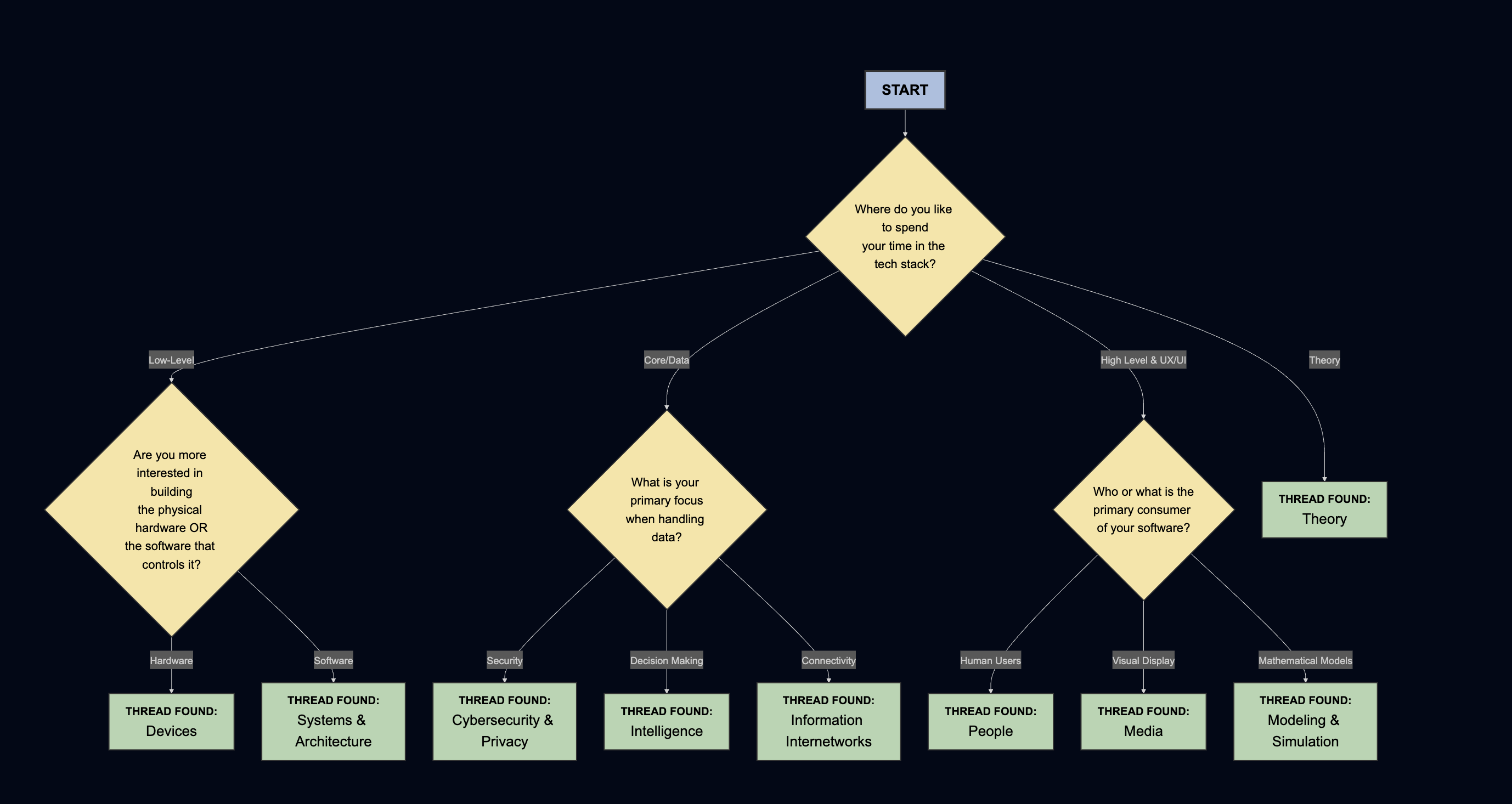
Before you start looking at graduation requirements, you need to figure out what you actually enjoy doing. Use the flowchart above as your starting point. Do you like tinkering with physical hardware, or do you prefer building the sleek user interfaces that people interact with every day? Are you fascinated by how data is securely transmitted across networks, or are you more interested in the mathematical models that power artificial intelligence?
Action step: Write down your top three favorite tech topics and, just as importantly, the two areas you absolutely hate working on. Honesty here will save you from a miserable semester later.
Cross Reference Industry/Academic Roles
Don’t pick a specialization just because the name sounds cool, pick it because it leads to the career you want. Look at entry-level job postings for roles that catch your eye (like Data Scientist, Embedded Systems Engineer, UX Researcher, or Backend Developer) and see what skills they actually require.
- Want to work in Game Dev? You’ll likely want to lean into Media and Systems & Architecture.
- Aiming for Cybersecurity? Look closely at Cybersecurity and Privacy as well as Information Internetworks and Systems. Reverse engineer your academic choices based on the real-world job market.
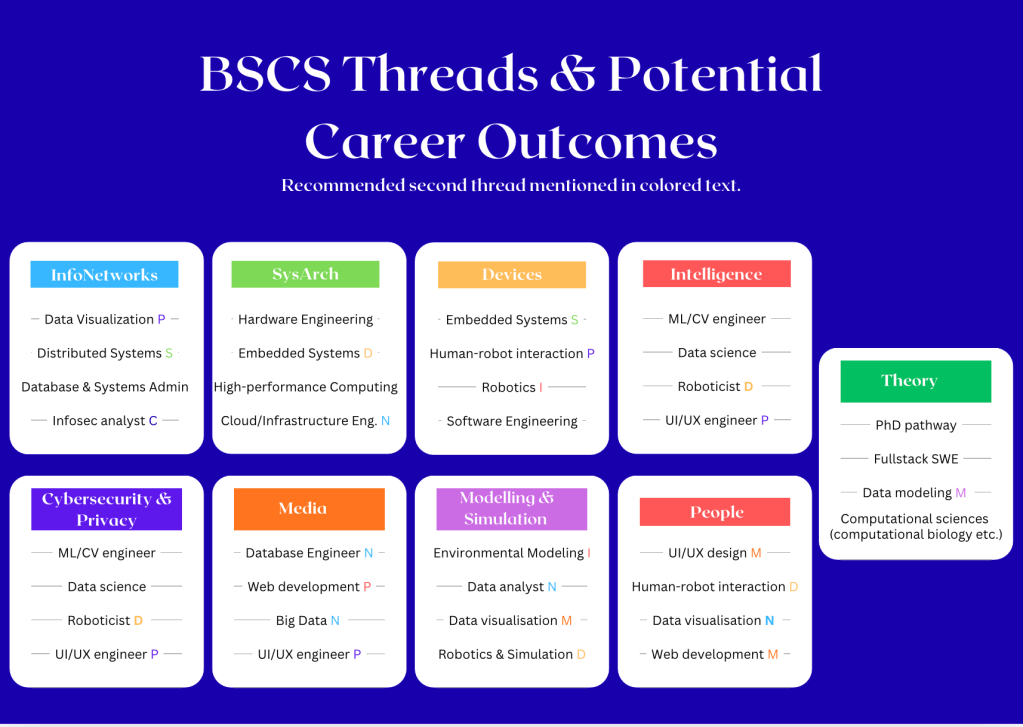
Our infographic below shows some options on how certain threads can lead into certain career fields. Note that there are of course multiple paths into every career, but these pathways listed below are the most common and have the most course overlap between real life work of that field and required coursework.
Find Course Overlaps
When choosing two different tracks or threads, efficiency is your best friend. Many specializations share foundational prerequisite courses. Look for the “bridge” classes that satisfy requirements for multiple paths. Identifying these overlapping courses early allows you to make progress toward your degree while keeping your options open, preventing you from wasting credit hours on classes you ultimately won’t need.
Narrow Thread Combinations Down
A specialization might sound perfect on paper, but the actual day-to-day coursework might be a nightmare for your learning style. Don’t just read the thread titles. Instead, actually dig into the actual course catalogs and syllabi. These can be found online on the professor’s website, reddit, discord, or other sites. Don’t be afraid to do your own research into the course and the professor!
- If a thread requires three semesters of heavy calculus and you despise math, cross it off the list.
- If a thread is heavily project-based and you prefer theory and exams, pivot. Filter your choices based on the actual work you will be doing in the classroom.
Test Scenarios In The DegreeWorks “What If” Section
Your university’s DegreeWorks (or equivalent degree audit system) is the ultimate reality check. Before committing to anything, log in and use the “What If” tool. This allows you to plug in different combinations of threads/majors to see exactly how the credits you already have apply to those specific requirements. It will instantly show you how far along you are and exactly how many credits you still need to graduate under that specific scenario.
Talk To Upperclassmen
The official course catalog won’t tell you the whole truth, but the juniors and seniors will. Reach out to upperclassmen who are already taking the paths you are considering. They can give you the unfiltered reality of what the workload is actually like.
- Ask them which classes are notorious “weed-out” courses.
- Find out which professors are the best (and which ones to avoid).
- Ask how well certain thread combinations actually pair together when midterms roll around.
Make a Semester-By-Semester Roadmap
Once you have your thread combination locked in, it is time to build out your master spreadsheet. Map out every remaining semester from now until graduation.
- Balance the load: Never stack three brutally hard, project-heavy core classes in the same semester. Balance them out with easier electives or humanities.
- Check prerequisites: Make sure you are taking the required intro classes early enough to unlock the capstone classes you need for your senior year.
- Factor in flexibility: Leave a little wiggle room in case a class fills up before your registration ticket opens.
Having this roadmap and following this whole guide will ensure you are adequately prepared to choose your threads and begin your Computer Science academic career!
P.S. Don’t be afraid to choose wrong, you can always switch threads later on as your interests evolve!


Leave a Reply