

By Alexander Hu and Xavier Genio
- Introduction
- The Guide
Introduction
One of the most important factors that decide where you end up working after graduation is what type of internships you do. Getting a first internship early, no matter the company, can have a huge snowball effect on your career. Landing your first one may be daunting, but it doesn’t necessarily have to be.
In our experience, the way to land your first is very different from what you would want to do to land a subsequent internship. Landing your first internship is often the hardest because you’d be applying with zero experience, but it becomes easier once you have some on your resume. There seems to be a lot of good advice on how to land internships and how to word your resume when you have experiences. However, how would you fill out a resume with limited experiences?
Our page will provide a straightforward guide on how to navigate the application cycle and optimize your resume. It’ll boost your chances of getting noticed by recruiters, landing interviews and passing it, especially for students with limited experiences.
The Guide
Here, we provide a 7-step guide to getting your first internship from start to finish.
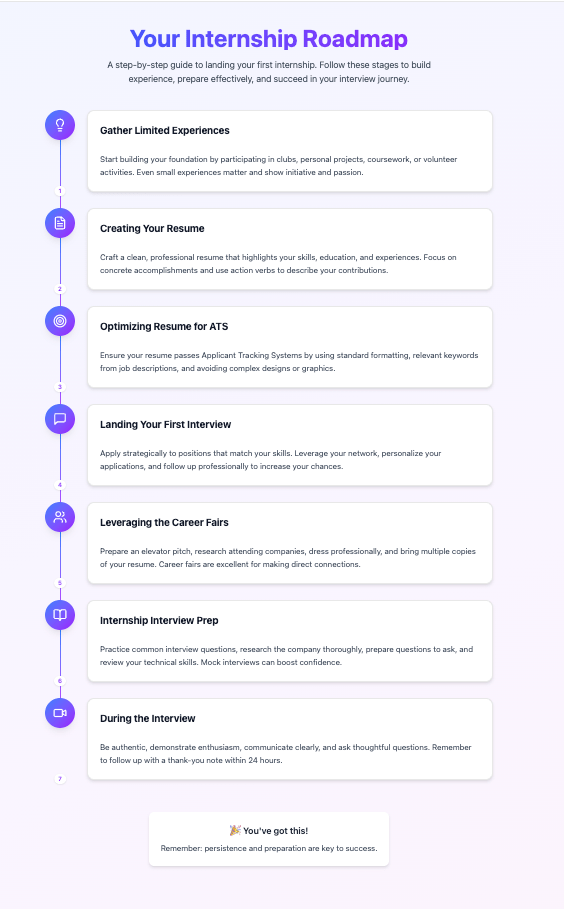
1. Gather Your Limited Experiences
You may not have “real-world” experience but you probably have gained valuable skills through class projects, clubs, or part-time jobs. Create a new document to help brainstorm these skills and experiences, focusing on what you learned, solved, and the results.
Here are some things you can include in the document:
- Class projects, personal projects, or any research you’ve done
- Volunteer work, club involvement, or part-time jobs
- Focus on skills and outcomes rather than titles
- What you did and accomplished for these experiences
Tip – Think of any transferable experience: teamwork, leadership, and problem-solving.
You can include high school experience for now, but eventually, you’ll start removing them as you gain more college-level experiences, internships, and projects!
2. Creating Your Resume
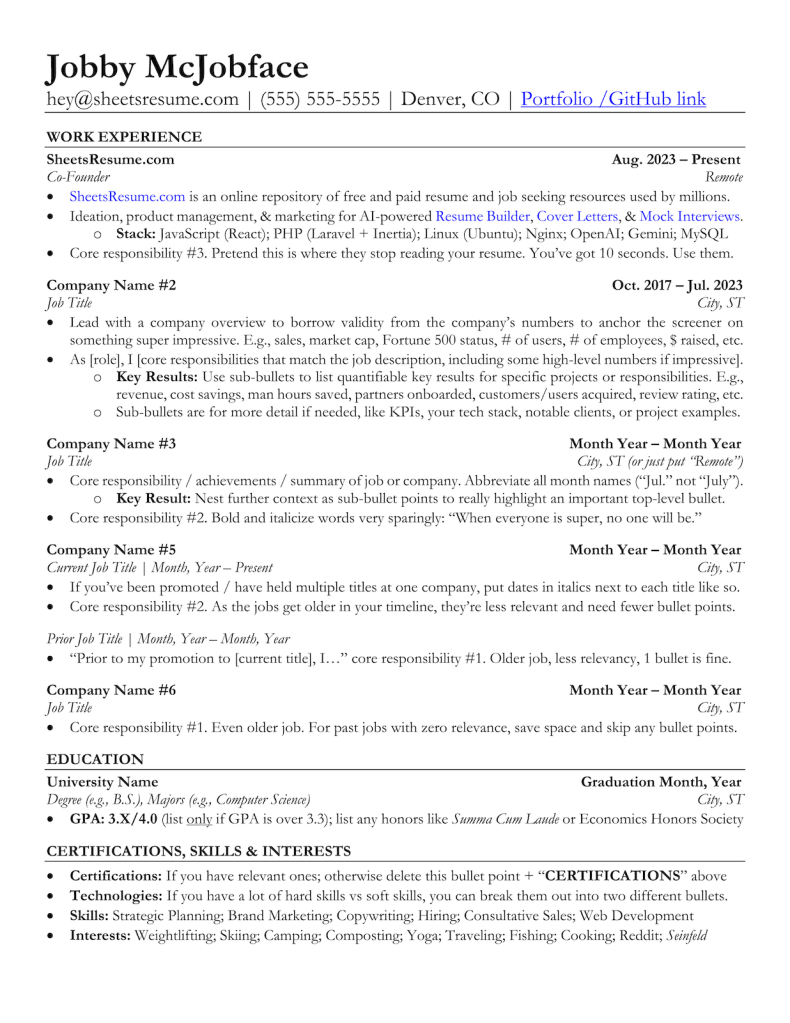
So now that you have a brainstorming document, you can start creating your resume using this information. There are a plethora of resources on the internet that can help but here is a brief overview of what you should include:
- Keep it to one page with clear headings and sections
- Your contact information and relevant websites (like linkedin)
- Use action verbs and quantify results when possible
- e.g., “led a team of 3 to complete xx project resulting in yy% improvement of zz”
- Education, Projects, Skills, Experience, and Relevant Coursework
- also include your roles and the organization/company (if applicable)
- Make sure it’s easy to read
- use bullets and consistent formatting
Georgia Tech’s Career Services provides a great and more detailed guide on creating a resume. Here are some key topics that you should keep in mind from it:
- Resume Sections
- The “SAIL” methodology
- skill, achievement, impact, learning
- Resume Action Verbs
- Additional Pro Tips
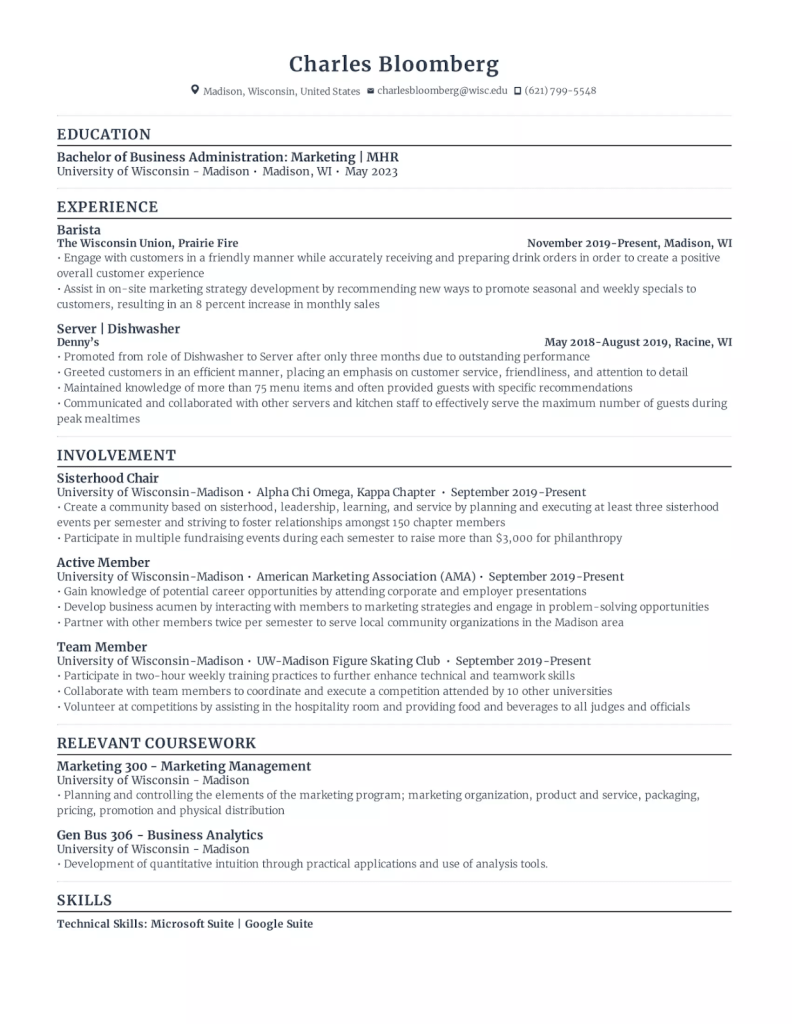
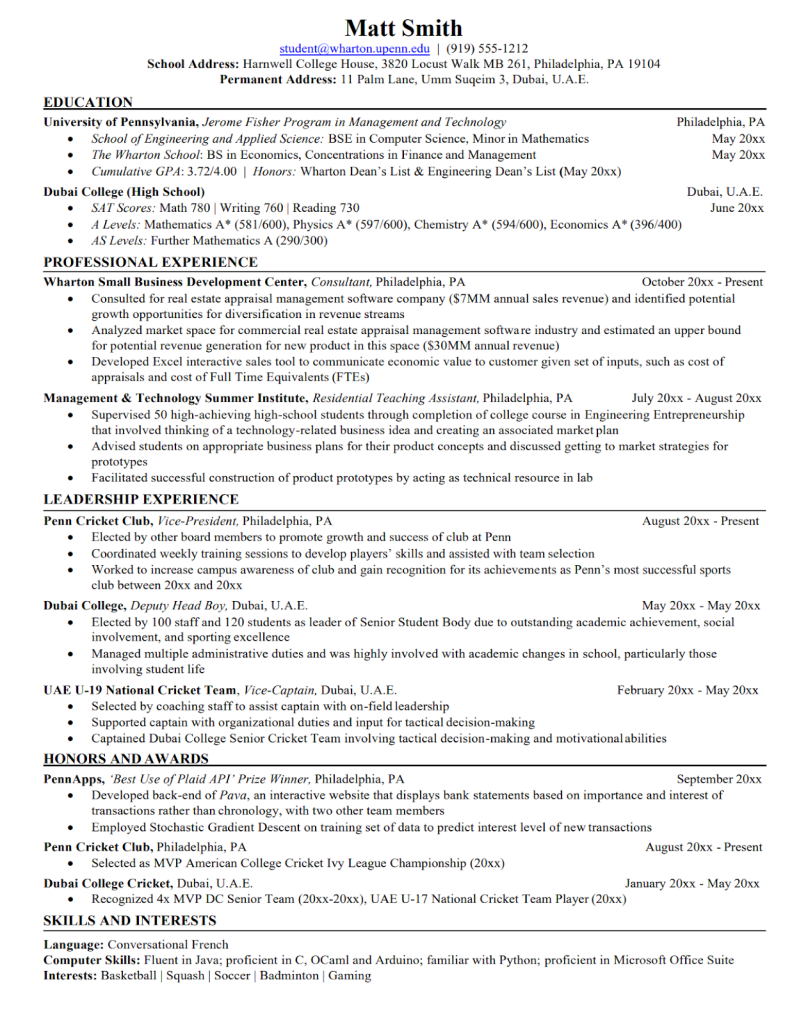
From UPenn Careers Services and Rezi Resume First-Year Examples
Here are some other useful sources that you can reference when creating your resume:
3. Optimizing Resume for ATS
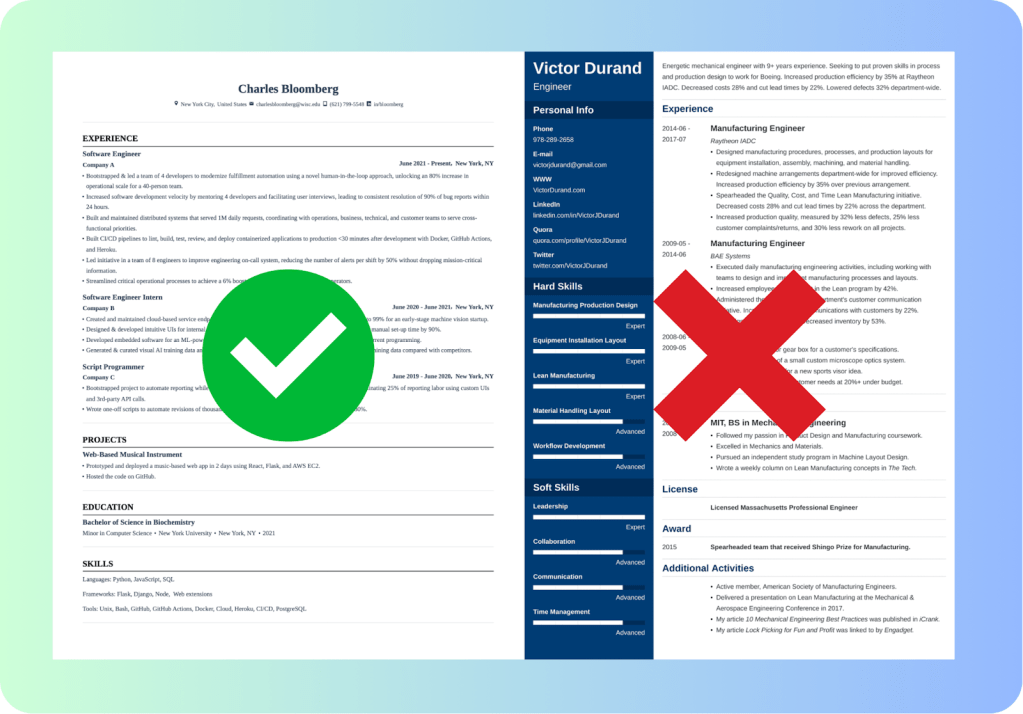
After creating your resume, you need to first check if it can pass the Applicant Tracking System (ATS). This is a software that many employers use to automatically sort the hundreds of applications they get for a given job opportunity.
BUT FIRST… You will need to first find the type of jobs you are interested in doing. Through various job boards (like linkedin, indeed, etc), find real internship postings and their descriptions:
- Analyze what the requirements are
- Research the companies and their missions
- Write down key words that you see
Ideally, you’d want to cater your resume specifically to every job you apply for. Tailoring your resume gives you a better ATS score for any given job. However, realistically, this isn’t very sustainable especially if you are mass-applying to various jobs. Research the common phrasings and words that constantly show up and include them somewhere in your resume.
Tip– If you find that there are different roles with different descriptions, consider creating other versions of your resume to cater to these roles.
- This helps with balancing the quality of your resume with the quantity of job applications
| Do’s | Don’t’s |
| Use keywords from the job description in context with your experiences | Don’t use tables, images, and unconventional fonts |
| Use standard section headers like “Experience,” “Projects,” “Skills” | Don’t be vague when writing out your experiences |
| Keep formatting (bullet points, fonts, etc.) simple, consistent and readable to the ATS | Don’t include non-relevant experiences or jargon just to fill the resume |
| Include relevant skills and experiences | Don’t use fancy or complex formats |
You can check if your resume would pass the ATS through free ATS checkers by searching for them (like JobScan)
4. Landing Your First Interview
The job application process may start out confusing to those who are new to the job market.
Now it’s time to actually apply to jobs. Each company may have different requirements when it comes to their application but you can expect the following:
- They’ll either prefer applications directly through their website, through a third party (like Workday), or accepts either one
- Manually inputting your experiences each and every time
- Sometimes they have an automatic system that pulls from your resume but usually it doesn’t format properly
Since you probably have limited experiences, the key is to maximize your chances by applying strategically and consistently:
Apply Early and Broadly
- Don’t limit yourself to top-tier companies
- Some jobs fill up their positions before the deadline
- Smaller companies tend to get less applicants
Leverage Networking
- Reach out to alumni, professors, or club connections
- Get referrals!!
- It helps increase your visibility to the hiring team and gives you an automatic advantage
- Networking events give you the chance to connect to those working in your desired field
- See the “Leverage the Career Fair” step in this guide!
Tailer your resume and cover letter for each application
- Check out the “Optimize Resume for ATS” if you haven’t
- Cover letters should show that you took the time to research the company and your relevant experiences to the job you are applying for
Consider asking for follow-ups or (if you’re brave enough) cold-emailing a company’s hiring team
- Many companies don’t email rejections
- Shows continued interest in the job role
- Increases visibility outside of the ATS
- BUT keep these emails short and professional since these hiring teams are busy with applications
These are just some ways to increase your chances of getting to the interview stage of the hiring process.
5. Leveraging the Career Fairs

Most colleges host career fairs where students can directly meet recruiters and learn about job opportunities. These can give you the chance to make a personal impression and stand out amongst fellow applicants.
For Georgia Tech specifically, you can find the schedule here.
Preparing for the career fair:
- Research companies before attending
- Know their roles, values, and recent news
- Where they will be located during the event
- Plan which companies you’d like to go to and in what order
- Create and practice a 30-second elevator pitch summarizing who you are, what you bring, and what you are looking for
- remember what is on your resume
- Also prepare thoughtful questions to ask the recruiters
- Print multiple copies of your resume
- having too many is better than running out (10-15 copies)
- Place them into a folder
- Plan to dress professionally
During The Career Fair:
- Arrive early and visit your top companies first to avoid long lines
- Pitch yourself, ask questions and try to collect recruiters’ contact or LinkedIns to follow-up
- Treat your talk to the recruiter as a friendly conversation and not as a robotic script
- Get as many career fair application links since some companies provide special ones for attendees
6. Internship Interview Prep

Okay, so you’ve landed your first interview! You will now need to prepare to talk to the hiring team in real-time.
The best way to prepare is to practice through mock interviews. Friends and family can help but if you need someone else, your college probably provides opportunities to do so through their career services. For example, Georgia Tech has their Big Interview opportunity.
See this video for how to pitch yourself
General Tips:
- Practice behavioral questions using the STAR method (Situation, Task, Action, Result
- Prepare technical or role-specific questions if applicable
- Research the company’s mission, products, and recent news
- Mock interviews with friends, career centers, or mentors can boost confidence
- Practice being conversational and not robotic
Depending on the company, they may start with a behavioral or with a technical interview (if applicable). They can also have several hiring stages before officially hiring you so research them and be prepared.
Example:
The Interview Question: “Tell me about a time you had to tackle a complex technical problem.”
- Situation: “In my database systems course, our major assignment involved building the core backend components of a database engine.”
- Task: “My specific task was to implement a transaction manager from scratch in Java. It needed to include robust logging and crash recovery mechanisms to ensure absolute data integrity during simulated system failures.”
- Action: “I started by designing a Write-Ahead Logging (WAL) protocol to guarantee that all transactions were securely recorded to disk before committing. While implementing the recovery phase, I encountered a tricky concurrency bug where aborted transactions were improperly rolling back. I systematically stepped through the thread execution using a debugger, isolated the race condition, and refactored the Java code to enforce stricter lock management during the undo and redo phases.”
- Result: “The transaction manager successfully passed all simulated crash tests with zero data loss. The implementation earned full marks, and the experience gave me a much deeper, practical understanding of how databases guarantee reliability under the hood.”
Common Behavioral Questions:
- “Can you tell me about yourself?”
- “What are your strengths and weaknesses?”
- “Why do you want to work here?”
- “What skills make you a good fit for this job?”
- Interviewers can also ask questions about your resume, personality, and what you know about the company
For Technical Interviews:
- Practice communicating your thought process for a given problem by finding example questions
- Interviewers may also ask why you are doing certain actions
- Understand the fundamentals of the job you are applying for
7. During the Interview
The interview is the most crucial part of the hiring process so it is important that you do several things:
- Arrive early (or log in early for virtual interviews).
- Dress professionally and maintain good body language
- Listen carefully, answer clearly, and use examples from projects, classwork, or volunteer experience
- Ask insightful questions about the team, projects, or company culture
- Follow up with a thank-you email within 24 hours, reiterating your interest and fit
- Use the STAR method (Situation, Task, Action, Result) when answering
- but be sure it doesn’t sound very robotic or scripted
- It is also important to show your enthusiasm and personality.
This guide does not provide specific major- or job-related technical interview advice so research the types of questions your job would ask and prepare accordingly. However some general tips are:
- Communicate and/or demonstrate your thought process clearly and concisely
- Ask clarifying questions before solving a problem
- If you make mistakes, acknowledge them, correct them, and act professional
Remember, your personality, enthusiasm, and ability to outwardly solve is just as important as having technical and fundamental knowledge. Even with limited experiences, first-time interns can stand-out and leave a strong impression.
Good Luck!


Leave a Reply