

By Aman Binu Kasim and Raymond Bian
CS majors, we all know the job market is cooked. Many of you have probably heard how difficult it can be to land internships or full-time roles. Millions of computer science graduates apply for jobs each year, and some postings receive hundreds of applications within hours.
Recent reports show that around 7% of CS graduates are unemployed and an additional 16% are underemployed. In other words, roughly one in four graduates may struggle to find a role directly in the field. Standing out in this environment requires more than simply completing coursework. Employers are looking for students who demonstrate initiative through projects, internships, technical practice, and involvement in the broader recruiting process.

Technical Problem Solving is one of the plays you can make to boost your recruiting abilities. A photo of competitors solving technical problems at the 2024 ICPC Southeast Regional Competition. Photo by Marianna Cao.
It might sound doomed, but the good news is that there are many opportunities available to students early in their college careers. However, navigating the recruiting pipeline can feel confusing if you do not know where to start.
We have spent time learning how to navigate this process ourselves. Raymond will be interning at Jane Street next summer, and Aman will be interning at Oracle. We’re here to walk you through the key parts of the process, including understanding recruiting timelines, building a resume, developing technical projects, practicing coding interviews, networking with recruiters, as well as tracking internship applications.
Quick Links
- Understanding the CS Recruiting Pipeline
- Building an Effective Resume
- Developing Technical Projects
- Practicing Technical Problem Solving
- Applying Strategically
- Networking With Recruiters and Peers
- Tracking Applications and Interviews
- Conclusion
Play A: Understanding the CS Recruiting Pipeline
The biggest mistake freshmen make is applying too late. Companies start recruiting for the summer as early as June-September the year prior. That’s almost 12 months in advance! Companies often continue recruiting through the new year, wrapping up many processes around January-February. Don’t worry if you’ve missed this window! Smaller companies will be scrambling to fill vacant spots right up until summer starts.
You can follow the general schedule for applying to internships:
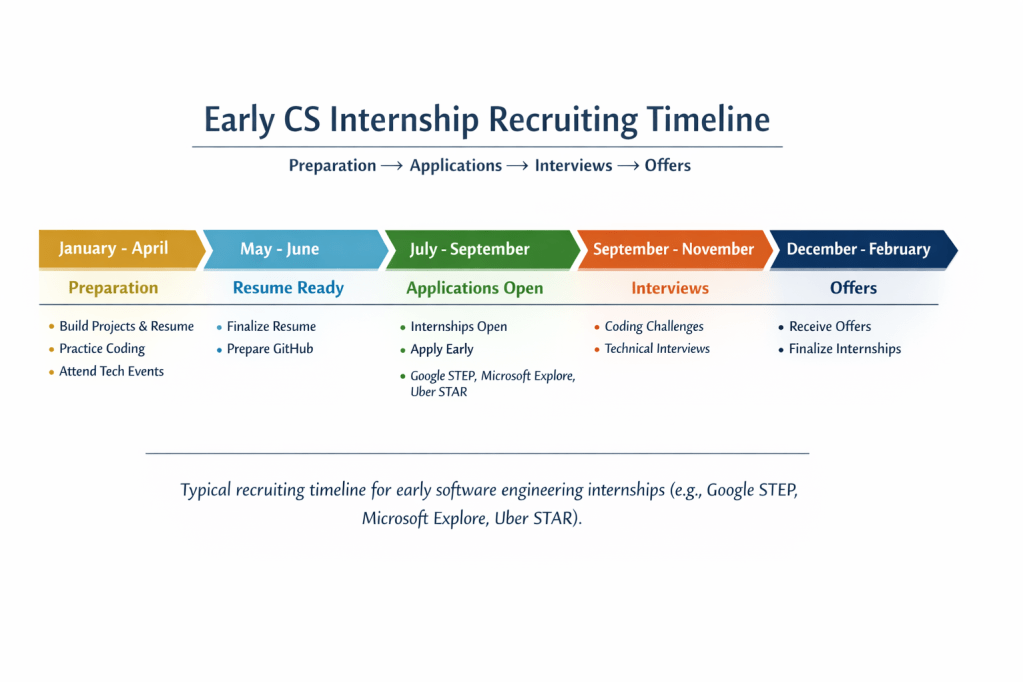
This info graphic details the early CS internship recruiting timeline, from preparation, applications to interviews and offers. The application cycle starts up to a year before the job start date! Infographic by Raymond Bian.
Contrary to popular belief, you can also land internships before your junior summer! There are several programs target freshman (and sophomore) college students: landing an internship freshman/summer year will propel into better and better internships. Some of these programs include
- Google STEP (https://www.google.com/about/careers/applications/buildyourfuture/programs/step)
- Microsoft Explore (https://careers.microsoft.com/v2/global/en/exploremicrosoft)
- Uber STAR (https://jobs.uber.com/en/teams/emerging-talent/)
The worst thing that can happen isn’t getting rejected 100 times: it’s not applying at all. Start sending those applications out, as soon as you have the resume to do so.
Play B: Building an Effective Resume
Your resume is what gets you through the first round. Recruiters skim through your resume in seconds. In those couple of seconds, they decide whether or not to hire you. Thus, your resume needs to communicate your strengths and experiences as efficiently as possible. If:
- You receive only rejection emails OR
- The only online assessments you receive are automated
Then your resume isn’t good enough.
There are two ways you can improve your resume. The first of which? Rewriting your current accomplishments in a better way. The biggest mistake we see students make on resumes is including tasks, instead of accomplishments. Recruiters care less about what you did, they care more about the impact of what you did (Read more on resume tips here). For example:
- Instead of writing: Worked on a website project.
- Write: Developed a full-stack web application using React and Node.js that allowed users to track study sessions and increased engagement among classmates.

One of the most important parts of a resume is making sure that your impact is communicated to the recruiter. You can do this by quantifying your results, and focusing on the impact rather than the what. Recruiters want to see how much value you can bring to their company! Infographic by Raymond Bian.
You can make this one step better by quantifying your impacts. How much did you increase engagement? How much impact did you exactly have? These are the questions recruiters like answered.
Finally, you don’t have to have a previous internship to make a strong resume! Any prior professional experience is a good placeholder! Work retail? Wait at a restaurant? These things show accountability and a willingness to learn in a new environment. You can also include class projects if you haven’t written any of your own. Ultimately, projects is where most people start:
Play C: Developing Technical Projects
Projects are how you prove that you can actually build things. Anyone can say they know Python or Java on a resume, but projects demonstrate how you apply those tools to solve real problems.
When recruiters review resumes, projects often stand out the most because they show initiative. They answer the question: What have you built outside of class requirements?
Good projects do not need to be extremely complex. What matters is that they demonstrate useful technical skills and thoughtful design. Some examples include:
- A web application with a backend database
- A mobile app solving a real-world problem
- A game or interactive application
- A data analysis tool or visualization project
- An automation script that saves time on repetitive tasks
If you already enjoy programming, this is the part of recruiting preparation that can actually be fun. Build things that interest you. Passion often leads to better projects and deeper understanding.

GitHub is the best way to show off your projects to recruiters and other computer scientists. Make sure to include documentation – technical communication is just as important of a skill as writing the code itself. Photo credit: https://cdn.mos.cms.futurecdn.net/W5LnBksnN2E3PTCdgDF9g3-1200-80.png
Once you have built something, host the project on GitHub. GitHub acts as a portfolio for developers. Recruiters and engineers sometimes look through repositories to understand how you structure code and organize projects.
Play D: Practicing Technical Problem Solving
Most technical interviews involve solving coding problems in real time. These problems typically focus on algorithms, data structures, and logical reasoning.
For many students, this is the most intimidating part of the recruiting process. The good news is that it is also one of the most predictable. Most interview questions fall into recognizable patterns that can be practiced.
Start by reviewing fundamental data structures such as arrays, hash tables, stacks, queues, trees, and graphs. Understanding when and why to use these structures is essential.
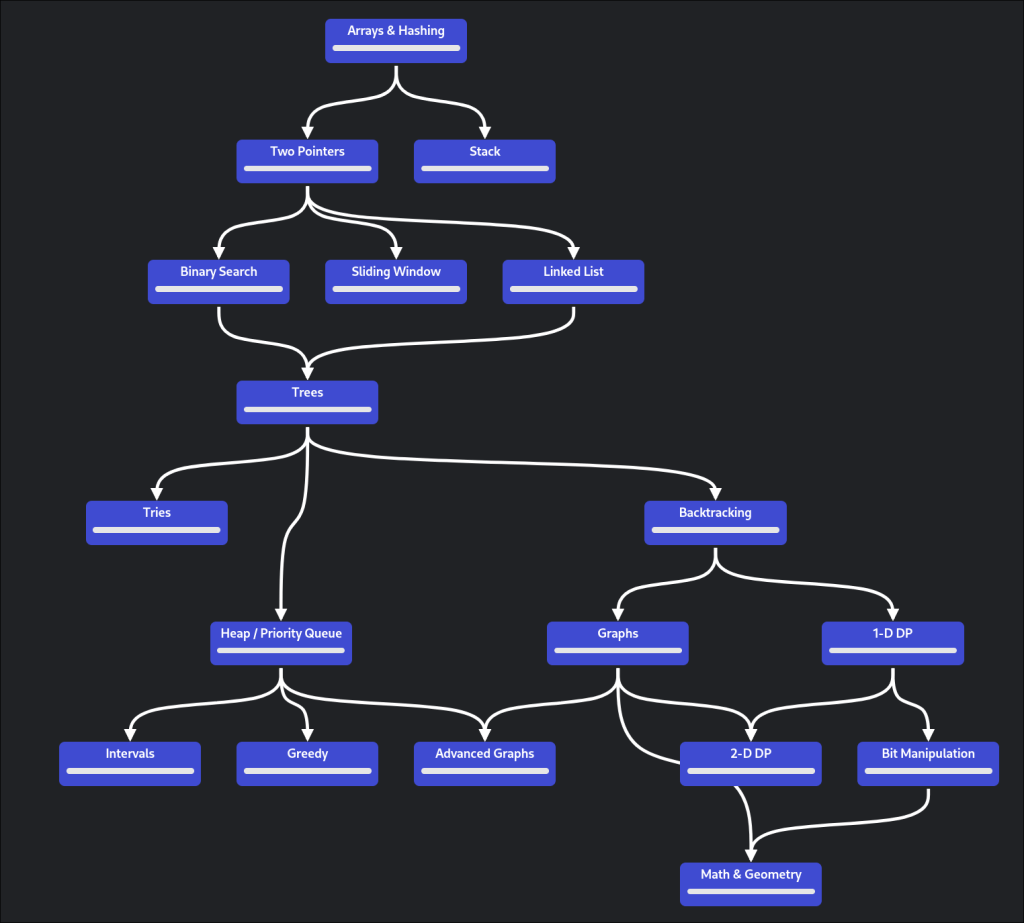
A roadmap of topics to practice your technical solving ability. Topics should be learned from top to bottom, an arrow from one topic to another denotes that the first topic must be learned before the second. Photo credit: neetcode.io/roadmap
Next, practice solving problems consistently. Platforms such as:
- LeetCode (https://leetcode.com/)
- HackerRank (https://www.hackerrank.com/)
- Codeforces (https://codeforces.com/)
Provide thousands of practice problems used in real interview preparation.
The key is consistency. Solving a few problems every day over several months is far more effective than cramming before interviews.
Another important skill is explaining your thinking out loud. During interviews, companies are not just evaluating whether you arrive at the correct answer. They are also evaluating how you communicate and reason through a problem.
Play E: Applying Strategically
The biggest factor when it comes to success vs failure when applying? Time. Apply right when the applications come out. Companies usually filter through applicants on a first-come-first-serve basis: making sure your resume is on the top of the stack is how you get a foot in the door.
Surprisingly, GitHub is a great place to find internships. There are repositories such as
- https://github.com/SimplifyJobs/Summer2026-Internships
- https://github.com/vanshb03/Summer2026-Internships
that are updated daily with a near-exhaustive list of top CS internship postings. Check these daily and apply to as many as you can, especially if this is your first internship. The first offer you get will be your stepping stone into bigger and more prestigious companies.
Play F: Networking With Recruiters and Peers
Networking is often misunderstood. It does not mean asking strangers for jobs. Instead, it means building connections and learning from people who have already gone through the process.
At Georgia Tech, there are many opportunities to meet recruiters and industry professionals. Career fairs, recruiting events, and tech talks provide chances to speak directly with company representatives (Check out a list of upcoming career fairs at Georgia Tech).
What has been more effective, in our experience, is just being friends and knowing the right people. Upperclassmen who have gone through recruiting often have useful advice about preparation strategies and interview experiences. Often times, they can give you referrals and launch you straight into the interview process.

The career fair is a great way to network and meet new people. But don’t be afraid to look around you – your friends and peers are the strongest network you have formed so far. Photo of the Georgia Tech Career Fair. Photo credit: https://careerfair.gatech.edu/files/2022/08/career_fair2.jpg
Play G: Tracking Applications and Interview Progress
Once applications begin, it becomes surprisingly easy to lose track of everything. Between dozens of companies, multiple interview stages, and different timelines, staying organized becomes critical.
Many students create an application tracker using a spreadsheet. This tracker typically includes:
- Company name
- Role applied for
- Application date
- Interview stage
- Notes or follow-up reminders
Keeping track of this information helps you stay organized and prepared for upcoming interviews.
It also helps you evaluate your strategy. If you notice that certain types of companies respond more often than others, you can adjust your focus accordingly.
It’s important not to get overwhelmed if your tracking spreadsheet is looking very red! That is the norm – anything else is the exception. It doesn’t matter whether you’ve applied to 30 or 50 or 1000 internships if you land at your dream company.
Conclusion
Recruiting for computer science internships can feel overwhelming at first. The timelines are confusing, the competition is intense, and it often seems like everyone else already knows what they are doing.
In reality, most students are figuring things out as they go.
The key is starting early and breaking preparation into manageable steps. Understanding the recruiting timeline, building meaningful projects, practicing coding interviews, networking with peers, and staying organized can significantly improve your chances of success.
The recruiting process is rarely perfect. You might receive many rejections before getting your first opportunity. That is normal.
What matters most is continuing to improve your skills and staying persistent throughout the process.
Everyone starts somewhere.




Leave a Reply