
Authors: Elaine Tang, Lindsey Zhang
Introduction
Every year, Georgia Tech students who live in off-campus housing waste approximately $4000 on rent and utilities during summer vacation. If you plan on working at an internship during fall or spring, you might even have to pay over $6000 for a room that you’ll be living thousands of miles away from.
Off-campus housing, a requirement for non-commuter students who don’t win the on-campus housing lottery, typically require a year-round lease. However, many students will not be using that space for a significant portion of the year. While subleasing or re-leasing the room removes the financial burden on students, off-campus housing management companies leave the responsibility of finding a replacement tenant to the individual student. Many students are not able to do so. Often, this is due to the complexity of understanding official and unofficial subleases and re-lets, lack of information on where most potential sublessees look for housing, and being overwhelmed by the process of advertising, logistics, and negotiations.
This guide will therefore help GT students who live in off-campus housing to efficiently find a sublessee or replacement tenant. This guide will not only help you cover your rent in summer, but also ensure that you understand the formal process and can effectively negotiate in your own interest.
The Steps
1. Gather information about your apartment and room
The first step to subleasing your off-campus room is to understand the information that your potential sublessee or replacement tenant will need to know. Just like how you assessed your housing options by comparing cost, amenities, location, and other key information, you now need to provide these details.
Find the following information based on the official website for your apartment, the housing agreement that you signed, Google Maps, and other various resources. The purpose of tracking this information is to create an advertisement that potential sublessees can understand at a glance.
| Key Information | What to Note |
|---|---|
| Building Name | Ex. The Standard at Atlanta |
| Lease Duration | Are the move-in and move-out dates flexible? Ex. Jan–Jul 2026 |
| Monthly Rent | What is the rent stated in your housing agreement vs. the current listed price? Ex. $1175/mo, excluding utilities |
| Contract Type | Does your apartment building do subleases or re-lets? Is it renewable for the sublessor/replacement tenant? Ex. Re-let, renewable |
| Room Type | What floor plan is your apartment? Is your room and/or bathroom private? Ex. Private room in a 4b2b |
| Roommates | Will there be roommates during the duration of the sublease? |
| Amenities | Are there in-unit laundry units? Does the building provide high-speed wifi? Study rooms? A gym? |
| Nearby Attractions | How is the proximity to grocery stores, public transportation, and GT campus? |
Sublease vs. Re-let:
A sublease (or a sublet) is a contract type where you (the sublessor) still holds financial responsibility over the contract. The person taking over for the duration of your leave is called the sublessee. Generally, you (the sublessor) will return and continue holding the lease after the sublessee leaves.
A relet (or a lease takeover) is a contract where the replacement tenant signs a new lease with the landlord/management company. This frees you (the leaseholder) from financial responsibility over the housing unit. Typically, the replacement tenant is eligible to renew the lease.
Confirm the type allowed with your landlord/management company. This may affect duration and renewal eligibility.
For ease of readability and brevity, this guide uses “sublease,” “sublessor,” and “sublessee” to refer to both subleases and relets.
2. Decide your subleasing price
The next step is to set a price for your sublease. Take some time to understand how much potential sublessees are willing to pay. This is typically dependent on the season or semester, as well as how soon they will require housing.
Subleases typically allow you (the sublessor) to set your own rent; therefore, prospective sublessees tend to negotiate on rent and utilities. While re-lets have less negotiating room as the replacement tenant will have their own housing agreement, some may still choose an informal agreement on partially covering rent.
For example, since most off-campus apartments only use 12-month leases, summer sublessees tend to have more options as there are more individuals subleasing than there are prospective summer interns. However, spring semester subleases may have greater flexibility since most prospective sublessees are returning Georgia Tech students who had a fall internship.
While the price you set is generally capped at your contractual rent, there is often room for negotiation below the cap. Other factors to consider for setting your price include:
- How much are you willing to negotiate down to? You may want your initial offer to be higher.
- Will your monthly price include utilities?
- What is the quality of your apartment?
3. Create your advertisement
Once you have decided on an initial price, it’s time to get the word out! In Step 1, you’ve already done the work of compiling the key information that you’re going to add to the advertisements.
To make an attention-catching, appealing advertisement, you’d want to adapt your advertisement to each platform. For example, a Facebook group post can be longer (ex. 200 words) and include images of the apartment and room. However, a GroupMe message needs to be more concise (under the 450 character limit). If possible, add images of the floor plan, apartment, and room.
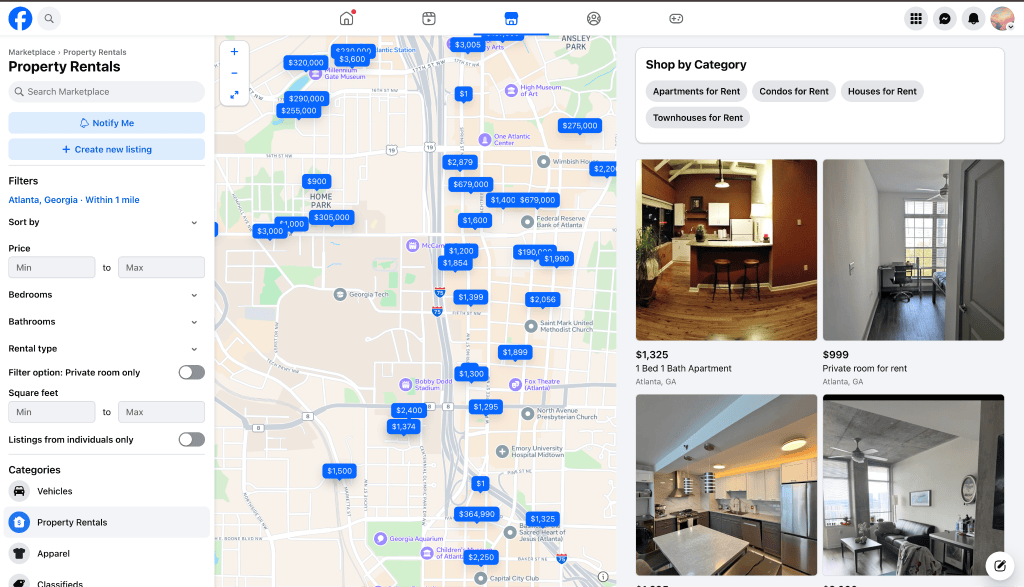
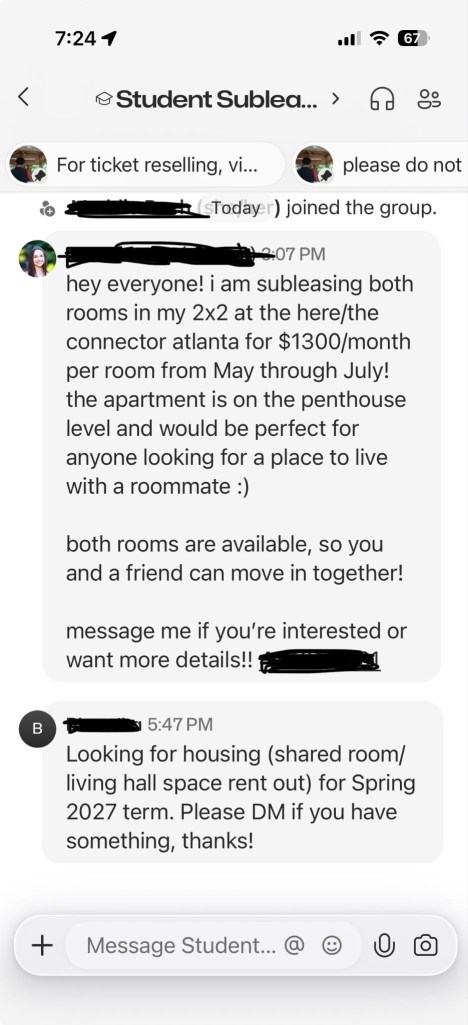
One tip is to include emojis and attention-grabbing phrases in order to draw in potential sublessees. The way you choose to phrase your advertisement can also make you seem more personal or more professional.
Lastly, include a preferred contact method in the advertisement so that prospective sublessees can get in touch!
4. Post your advertisement
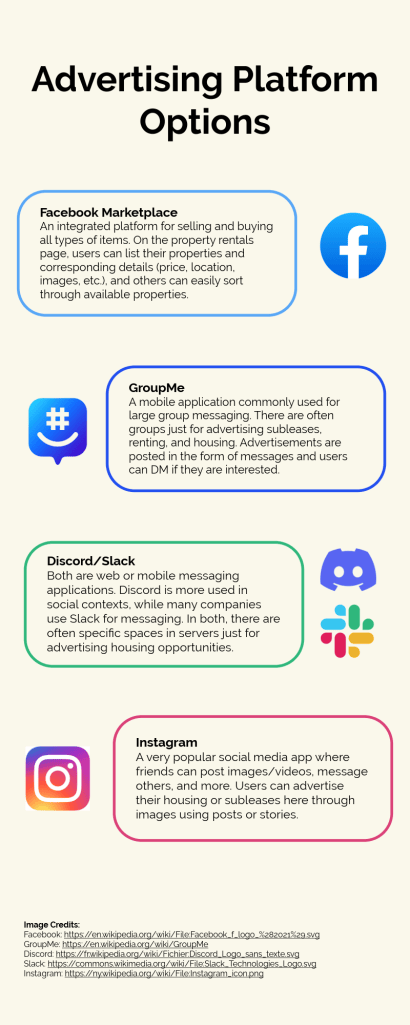
Now that you have a couple different advertisements written for longer posts and shorter group chat messages, you can post them to the right platforms! The most common platforms for finding housing near Georgia Tech and Atlanta are Facebook groups and GroupMe. The following infographic walks through a few of the most popular options.
Set up notifications for your posts, so that you can provide timely responses.
5. Spread word about your advertisement
Tell your friends! Often, people sublease from those they already know. Let your friends know that you’re looking to sublease your apartment. Maybe they know someone who needs a place. Based on the likely demographic that would need housing during the time range that you’re offering, you can also cater word of mouth to GT upperclassmen, GT freshmen, and interns from other colleges.
6. Talk and negotiate with potential sublessees
Once prospective sublessees have reached out, there will usually be an information-seeking and negotiation process. Make sure that the information you provide are accurate. If you’re uncertain, reach out to your landlord or apartment management.
During the cost negotation process, make sure that you know what your bottom line is; otherwise, the negotiation may seem unprofessional or lacking in confidence. Additionally, do research on the prices being offered by other sublessors for similar apartments.
When communicating with prospective sublessees, it’s important to respond to messages in a timely manner to maintain trust and reliability.
7. Sign your sublease or re-lease contract
Once a price has been agreed upon, draw up a contract if there is no formal application with the apartment management. If there is an application process, reach out to your landlord or apartment management to formally begin the process. Your landlord/management should be able to provide you with all relevant documents; ensure that you and your sublessee sign them in a timely manner. Note that off-campus housing often have a transfer fee, which is the responsibility of the sublessor.
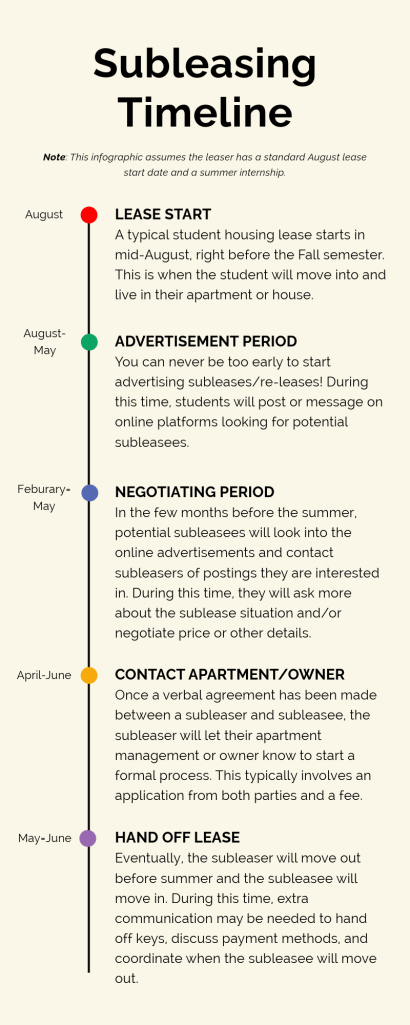
The following infographic provides a helpful timeline for you to keep track of which step you should be at. Your specific timeline may differ based on your housing situation, but the general steps apply.
Thanks for reading and good luck!


Leave a Reply